
(215) 545-4024
255 S. 17th Street, Suite 2507, Philadelphia, PA 19103
Monday- Friday
8:00 am- 5:00 pm.
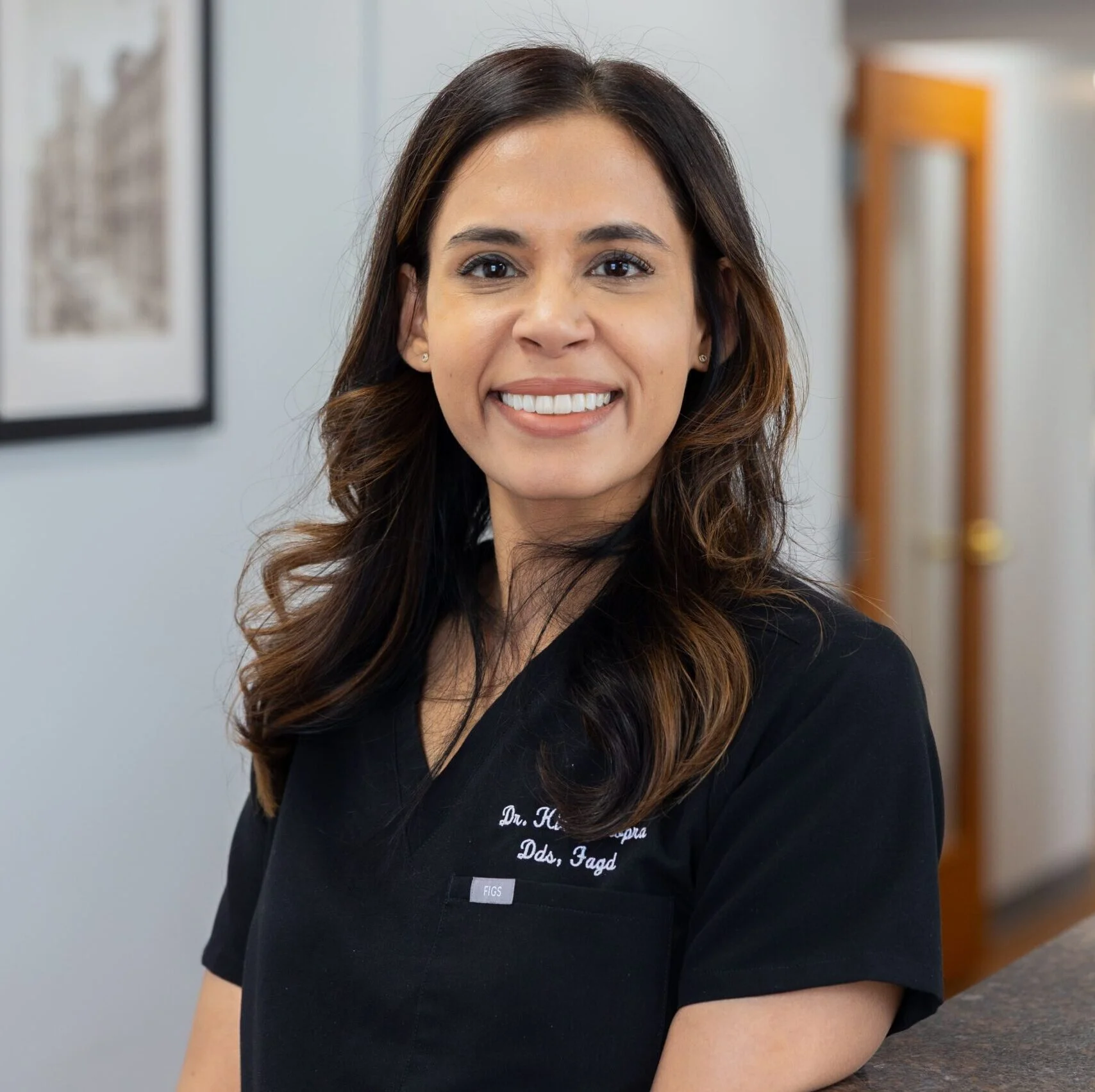
By Kirti Chopra, DDS, FAGD — General dentist, Smile Design Studio by KC, Rittenhouse Square, Center City Philadelphia · Kois Center Graduate with Honors
A treatment plan is easy to mistake for a list of procedures. It is closer to an argument: here is what I found, here is what is causing it, and here is the order in which things should happen as a result. I build my plans so a patient can follow that argument and push back on any step of it. The steps below are the ones I work through in every case, from a single crown to a plan that covers the whole mouth.
The American Academy of Periodontology states the principle plainly: without a proper examination, a proper diagnosis cannot be made and treatment cannot commence (American Academy of Periodontology, Diagnosis and Examination). My new-patient comprehensive exam covers the teeth, gums, bite, and airway together, and I do not propose treatment until it is finished.
An iTero digital scan is taken at every new-patient exam, along with photographs, and X-rays when they are clinically needed. X-rays are not routine: the ADA and FDA guidelines say dentists should order radiographs only when they expect the additional diagnostic information to affect patient care (American Dental Association and U.S. Food and Drug Administration, The Selection of Patients for Dental Radiographic Examinations, revised 2012). A systematic review of intraoral scanners found that, compared with conventional impressions, they can be used reliably for diagnostic purposes and short-span scanning, with more deviation on full-arch scans (Abduo & Elseyoufi, Accuracy of Intraoral Scanners: A Systematic Review of Influencing Factors, European Journal of Prosthodontics and Restorative Dentistry, 2018). I use the scan as a diagnostic record, and as the baseline every later visit is compared against.
This is the step that makes a plan different from a checklist. A worn edge, a failing crown, and a restoration that keeps needing attention can each have more than one cause. Tooth wear, for example, usually has more than one cause, typically grinding together with acid erosion (Loomans & Opdam, A guide to managing tooth wear: the Radboud philosophy, British Dental Journal, 2018). My Kois Center training is organized around comprehensive diagnosis, occlusion, risk assessment, and treatment sequencing, and this is where I use it: asking what is driving each finding before deciding what to do about it.
A formal classification can help organize the same thinking. The American College of Prosthodontists defines four classes for the completely dentate patient, from an uncomplicated situation to the most complex, each differentiated by specific diagnostic criteria, to support systematic diagnosis (McGarry et al., Classification system for the completely dentate patient, Journal of Prosthodontics, 2004).
Once the causes are clear, the question becomes sequence: what has to happen first, what can wait, and what one stage does to the next. Gum health usually comes early in that order, so that restorations are placed against healthy, stable gum tissue: restoration margins that reach into the gum’s attachment are associated with inflammation and, in some cases, loss of supporting tissue (Jepsen et al., Periodontal manifestations of systemic diseases and developmental and acquired conditions: Consensus report of workgroup 3 of the 2017 World Workshop, Journal of Periodontology, 2018). The order is different in every case, and a plan with several stages can run for months.
Some plans stay small. Others, such as a missing tooth, call for a decision between options that each change what comes next, which I have laid out in choosing how to replace a missing tooth. When the plan spans the whole mouth, the approach is the one described in full mouth rehabilitation, and where the question is how much of a tooth to restore, I have covered the choice in veneers vs. crowns.
Treatment is not always the right answer. In the management of tooth wear, for example, restorative treatment is not always indicated, even in severe cases, and where a patient has no complaints, counselling and monitoring is probably the best option (Loomans & Opdam, A guide to managing tooth wear: the Radboud philosophy, British Dental Journal, 2018).
The same paper says an explanation of the possible treatment options and expected complications should be part of informed consent. I build both into the plan: I lay the alternatives out side by side, and waiting is one of them.
Patients leave knowing what I found, what I recommend, what the alternatives are, including waiting, and what it will cost, in writing, before anything begins. Every patient is seen by me personally, so the person who built the plan is the person who explains it.
Will I be told to do everything at once?
No. A plan is sequenced, and some parts of it can wait. I explain which parts are urgent, which are not, and what changes if a step is delayed.
What if I only want one thing addressed?
That is a reasonable starting point, and I still look at the whole mouth first, because the tooth that prompted the visit is often connected to something else. What gets treated, and when, is your decision.
Does the plan include cosmetic goals?
Yes. A plan accounts for how your teeth fit and function, what your gums and bone are doing, how much structure each tooth has left, and what you want your smile to look like and last.
Do I have to start treatment right away?
No. Waiting is one of the options I lay out, and some findings are monitored rather than treated.
Can a plan change once it has started?
It can. A plan is built from what was found at the exam, and if something new comes up during treatment, I explain what it changes before going further.
Is the written plan a promise of a result?
No. It sets out what I found, what I recommend, and the alternatives. Results depend on each patient’s own teeth, gums, and bite, and nothing is guaranteed in advance.
Who builds and explains my plan?
I do, personally. Every patient is seen by me, from the exam through the plan.
To schedule an exam with me at Smile Design Studio by KC, call 215-545-4024 or request an appointment online.
Kirti Chopra, DDS, FAGD, is a general dentist and the owner of Smile Design Studio by KC in Rittenhouse Square, Center City Philadelphia. She earned her DDS from Indiana University School of Dentistry, where she was inducted into Omicron Kappa Upsilon, the national dental honor society, in 2018. She is a Fellow of the Academy of General Dentistry, a Kois Center Graduate with Honors, and an AACD Accreditation Candidate, written examination passed. She completed Bioclear Method training at the Bioclear Learning Center.
About Dr. Kirti Chopra at Smile Design Studio by KC · About Dr. Kirti Chopra on kirtichopra.com
Kirti Chopra, DDS, FAGD, is a general dentist practicing cosmetic and restorative dentistry at Smile Design Studio by KC in Rittenhouse Square, Center City Philadelphia. She earned her DDS at the Indiana University School of Dentistry, where she was inducted into Omicron Kappa Upsilon. She is a Fellow of the Academy of General Dentistry, a Kois Center Graduate with Honors, and an AACD Accreditation Candidate, having passed the written examination.
(215) 545-4024
255 S. 17th Street, Suite 2507, Philadelphia, PA 19103
Monday- Friday
8:00 am- 5:00 pm.
© 2026 Kirtichopra. All Rights Reserved.


