
Full Mouth Rehabilitation: Who Needs It, What It Involves, and How Long It Takes
Written By Kirti Chopra, DDS, FAGD
Most dental problems are treated one tooth at a time, and that is usually right. Full mouth rehabilitation exists for the cases where it stops being right, where the same underlying problem is showing up on tooth after tooth, and repairing each one in turn means repairing all of them again in a few years.
What follows is how to tell whether you are in that situation, what the treatment actually involves, and honest answers to the two questions people ask me most: how long it takes, and whether changing the bite is safe.
The Signs That Usually Bring People In
Almost nobody arrives asking for full mouth rehabilitation by name. They arrive with one of these:
- Teeth that look shorter than they used to. Often noticed in photographs from ten years ago rather than in the mirror, because it happens too slowly to see day to day.
- Front edges that keep chipping. Small chips that get smoothed, then chip again somewhere else.
- Old crowns and fillings failing in clusters rather than one at a time.
- A bite that feels different, teeth meeting somewhere new, or one side contacting before the other.
- Widespread sensitivity as enamel thins across several teeth at once.
- Being told, repeatedly, that another tooth needs a crown.
Some wear is normal with age. A systematic review of tooth wear in adults found the proportion with severe wear rising from about 3 percent at age 20 to 17 percent at age 70 (Van’t Spijker et al., International Journal of Prosthodontics, 2009). So wear itself is not unusual. What matters is whether yours is ahead of that curve for your age, and whether it is still progressing, which is a question an examination answers, not a mirror.
What Full Mouth Rehabilitation Actually Is
It is a treatment plan that addresses the bite, the restorative needs, and the appearance of the teeth together, in a deliberate order, instead of treating each tooth as its own problem.
You will see the same treatment called full mouth reconstruction or full mouth restoration. These are the same thing; the terms are used interchangeably by different practices. “Rehabilitation” is the more common clinical term and “reconstruction” the more common one in patient conversation.
It is not a smile makeover. A smile makeover is led by appearance. Full mouth rehabilitation is led by function and structure; the teeth genuinely need rebuilding, with appearance planned as part of that rather than as the goal. In practice, the two often produce a similar-looking result, which is why they get confused, but they start from opposite ends.
Who needs it, and who does not
It tends to be appropriate when several of these are true at once:
- Extensive wear across multiple teeth, usually from years of grinding or a long-standing bite problem
- Several failing or aging restorations reaching the end of their lifespan together
- A bite that has shifted, or no longer meets evenly
- A combination of missing, worn, and heavily restored teeth that would be inefficient to address separately
One failing crown is not full mouth rehabilitation. Neither is one worn tooth, or a single missing tooth. Those are limited restorative cases and should be treated as such; recommending comprehensive treatment for a localised problem is overtreatment, and it is worth being direct about that.
The honest test is this: if you fixed each problem tooth individually, would the cause still be there afterwards? If the answer is yes, because the bite that wore those teeth down is still the bite you have, then a coordinated plan is doing something a series of separate repairs cannot.
Why it builds up
Almost always gradually. Years of grinding or clenching, which the American Dental Association notes most dentists see signs of in their patients; several rounds of restorative work placed over the years without a unifying plan; a bite that shifted slowly enough that nobody noticed. Acid erosion, from diet or reflux, accelerates all of it. Occasionally trauma creates the same situation suddenly, but that is the exception.
The common thread is that the cause is still active. That is why sequencing matters and why the order of treatment is not arbitrary.
The part people worry about: changing the bite
This is the question I get asked most, usually phrased as some version of “if you change my bite, will I end up with jaw problems?” It is a fair thing to ask, and it deserves a real answer rather than reassurance.
Rebuilding worn teeth often means restoring lost height, opening the bite back toward where it was before the wear. A 2024 review of the evidence concluded that a moderate increase in vertical dimension is safe and predictable in patients with their own teeth and a stable occlusion. Where people did report symptoms, they were mild and self-limiting, typically settling within one to two weeks as the muscles adapted, and long-term follow-up did not show temporomandibular disorders developing (Yadfout et al., Clinical, Cosmetic and Investigational Dentistry, 2024).
The system adapts by lengthening and relaxing the muscles, not by dragging the teeth back down to where they were.
That does not make it automatic. It depends on the change being planned rather than improvised, on the joints being assessed before anything is altered, and, most importantly, on testing it before it is permanent.
The trial phase, which is the part nobody expects
The single most reassuring fact about this treatment is the one people are least often told: you live in the new bite before it becomes permanent.
Once the plan is designed, it is built first in temporary restorations. You eat in them, speak in them, sleep in them, and come back so we can see how your muscles and joints have responded. If something is not right, the height, the way the teeth guide against each other, how it looks, it gets adjusted at that stage, when adjusting is straightforward.
Only once the temporary version is working does it get copied into the definitive restorations. So the irreversible part of the treatment happens last, on a design that has already been tested in your own mouth. That is the difference between a plan and a hope.
What the Process Involves
Four phases. The specifics vary considerably by case, but the order does not.The phases of a full mouth rehabilitation
| Phase | What happens | Typical timeframe |
| Diagnosis and records | Full examination, digital scans, imaging, photographs, and assessment of the bite, joints, gums and existing restorations | One to two visits |
| Planning and design | The records are used to design the finished result and work backwards into a sequence; gum health and any active disease are stabilised before restorative work begins, and the bite is settled before definitive restorations are made | Two to four weeks between records and the start of treatment |
| Treatment, in stages | The plan is built in temporary restorations and tested, then completed definitively. May include crowns, onlays, implants, or orthodontic movement depending on the case | Several months; longer where implants need healing time |
| Review and maintenance | Confirming the bite is functioning as designed, adjusting where needed, and protecting the result, usually with a night guard if grinding caused the original wear | Ongoing, with closer review in the first year |
How long it actually takes
Several months from the first records appointment to the final review, in most cases. That is a design feature rather than a delay: the treatment is sequenced because each stage depends on the one before it, and the trial phase needs enough time in it to be worth doing. Cases involving implants run longer, because bone needs time to integrate before the next stage can proceed. Cases needing orthodontic movement first run longer still. Purely restorative cases can move faster. What I can tell you before an examination is what determines the timeline. What I cannot tell you is your number; that comes out of the records, and anyone quoting you a duration before seeing them is guessing.What happens if you do nothing
Worth asking, and the answer depends on whether the wear is still progressing. If it is, teeth continue to shorten and the restorations that are already failing keep failing, and the treatment that would have been possible gets larger. A worn tooth that could have been rebuilt with an onlay may eventually need a crown, root canal treatment, or extraction. The window is measured in years rather than months, so there is no reason to rush the decision, but there is a reason not to leave it indefinitely. If the wear has stabilised and nothing is failing, monitoring with records, so that any future change is measured against something rather than remembered, is a legitimate plan.A case treated at the practice
Years of grinding had shortened every upper tooth on this patient. The teeth were rebuilt to their original length in stages, with the new bite tested in temporary restorations first.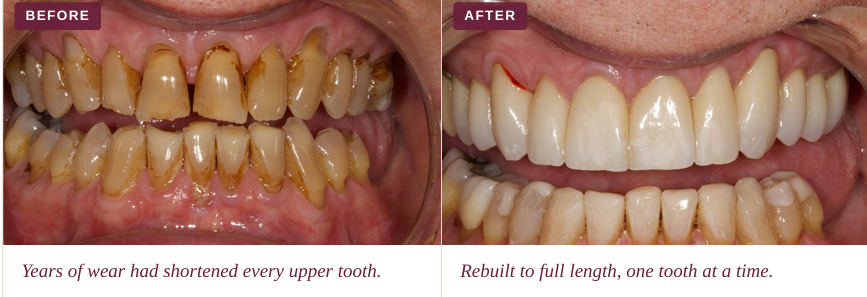
TREATMENT PERFORMED
Full mouth rehabilitation, planned in stages and carried out over months rather than in one appointment.
What Determines the Cost
Full mouth rehabilitation is not one procedure with one fee. It is a combination of individually priced treatments, crowns, onlays, possibly implants, possibly orthodontics, plus the diagnostic and provisional stages, and the combination differs so much between cases that a single national average would be misleading rather than helpful. That is why you will not find a credible one.
You can still build a useful estimate, and it is worth doing before your consultation so the numbers are not a surprise. Once you know roughly which procedures your case is likely to involve, FAIR Health Consumer, an independent nonprofit, publishes cost data for individual dental procedures by ZIP code. Pricing the components for your own area gets you far closer than any “full mouth” figure you will find online.
Your actual cost comes from your own treatment plan, built at a consultation once the scope is known. Financing, FSA and HSA payment, and a membership plan for patients without insurance are available.
On insurance: because the plan is made of separate procedures, coverage is assessed procedure by procedure rather than as a whole. Some components are commonly covered, and others rarely are. Submitting the finished plan to your insurer is the only way to know what applies.

Photographic and digital records taken at the diagnostic stage, the basis for the plan and the reference the result is measured against later.
Frequently Asked Questions
How do I know if I need full mouth rehabilitation?
The test is scope, not severity. If several teeth are affected at once by wear, failing restorations, or a bite problem, and fixing each one individually would leave the cause in place, a coordinated plan makes sense. One failing crown does not need one. A comprehensive examination is what settles it.
Is full mouth reconstruction the same as full mouth rehabilitation?
Yes. Reconstruction, rehabilitation, and restoration are used interchangeably for the same treatment. “Rehabilitation” is more common clinically, and “reconstruction” is more common in conversation. There is no difference in what is done.
If you change my bite, will I get jaw problems?
The evidence says no, for a moderate change in a patient with a stable joint. A 2024 review found increasing vertical dimension to be safe and predictable, with any initial symptoms mild and typically resolving within one to two weeks, and no temporomandibular disorders in long-term follow-up. What makes that hold is planning the change deliberately, assessing the joints first, and testing the new bite in temporary restorations before anything permanent is made.
How long does full mouth rehabilitation take?
Usually several months from records to final review. Implants add healing time; orthodontic movement adds more; purely restorative cases move faster. The sequence is what sets the duration, not the number of appointments, and a realistic figure comes out of your records rather than a general estimate.
Is it done in one visit?
No, and it should not be. It is completed in stages, with the new bite tested in temporary restorations before the definitive work is made. That trial stage is the reason the result is predictable, and it cannot be compressed into a single day.
Does it always involve implants?
No. Some plans include implants to replace missing teeth; many are built entirely around restoring and repositioning the teeth you have. Whether implants are part of your plan depends on what is missing and what the bite needs.
Will insurance cover it?
Partly, usually. Because the plan is a set of individual procedures, your insurer assesses each one separately rather than the plan as a whole, so coverage tends to be partial rather than all or nothing. Submitting the completed plan is the only reliable way to find out what applies to you.
What is the difference between this and a smile makeover?
A smile makeover starts from appearance. Full mouth rehabilitation starts from function and structure, in a mouth where the teeth genuinely need rebuilding, with appearance planned as part of it. The finished results can look similar, which is why the terms get mixed up, but the reason for treatment is different.
Can I have it done in stages to spread the cost?
Sometimes, and it is a reasonable thing to ask. Some plans divide cleanly into stages that can be separated in time; others depend on the whole bite being completed together to be stable. Which applies to you is a planning question, and worth raising early rather than partway through.
The Bottom Line
Full mouth rehabilitation is not a bigger version of a filling. It is a different approach to the problem, one that treats the cause across the whole mouth rather than the symptoms tooth by tooth, and it is worth doing only when the scope genuinely calls for it.
The two things worth knowing before you start: it takes months, by design, because the stages depend on each other; and the new bite is tested in temporary restorations before anything permanent is made, so the irreversible part comes last and comes after you have lived in the result. If someone proposes comprehensive treatment without a trial stage, ask why.
Talk It Through
If several teeth are wearing, chipping, or failing at once, a comprehensive examination is what tells you whether this is one problem or several.
Kirti Chopra, DDS, FAGD, is a general dentist practising in Rittenhouse Square, Center City Philadelphia, with a focus on cosmetic and comprehensive dentistry. She earned her DDS at the Indiana University School of Dentistry, where she was inducted into Omicron Kappa Upsilon, and graduated with honors from the Kois Center. She holds a Fellowship in the Academy of General Dentistry and is an AACD Accreditation Candidate, having passed the written examination. Colleagues refer her cases involving worn dentition, failing restorations, bite problems, and aesthetic concerns.
Full background and credentials · Smile Design Studio by KC, 255 S. 17th Street, Suite 2507, Philadelphia, PA 19103 · 215-545-4024
REFERENCES
- Van’t Spijker A, Rodriguez JM, Kreulen CM, Bronkhorst EM, Bartlett DW, Creugers NHJ. Prevalence of tooth wear in adults. International Journal of Prosthodontics. 2009;22(1):35–42. PubMed
- Yadfout A, El Aoud J, Merzouk N, Slaoui Hasnaoui J. Increasing vertical dimension of occlusion (VDO): review. Clinical, Cosmetic and Investigational Dentistry. 2024;16:135–142. PMC
- American Dental Association. MouthHealthy: Teeth grinding and jaw pain.
- FAIR Health, Inc. FAIR Health Consumer, dental cost lookup.