
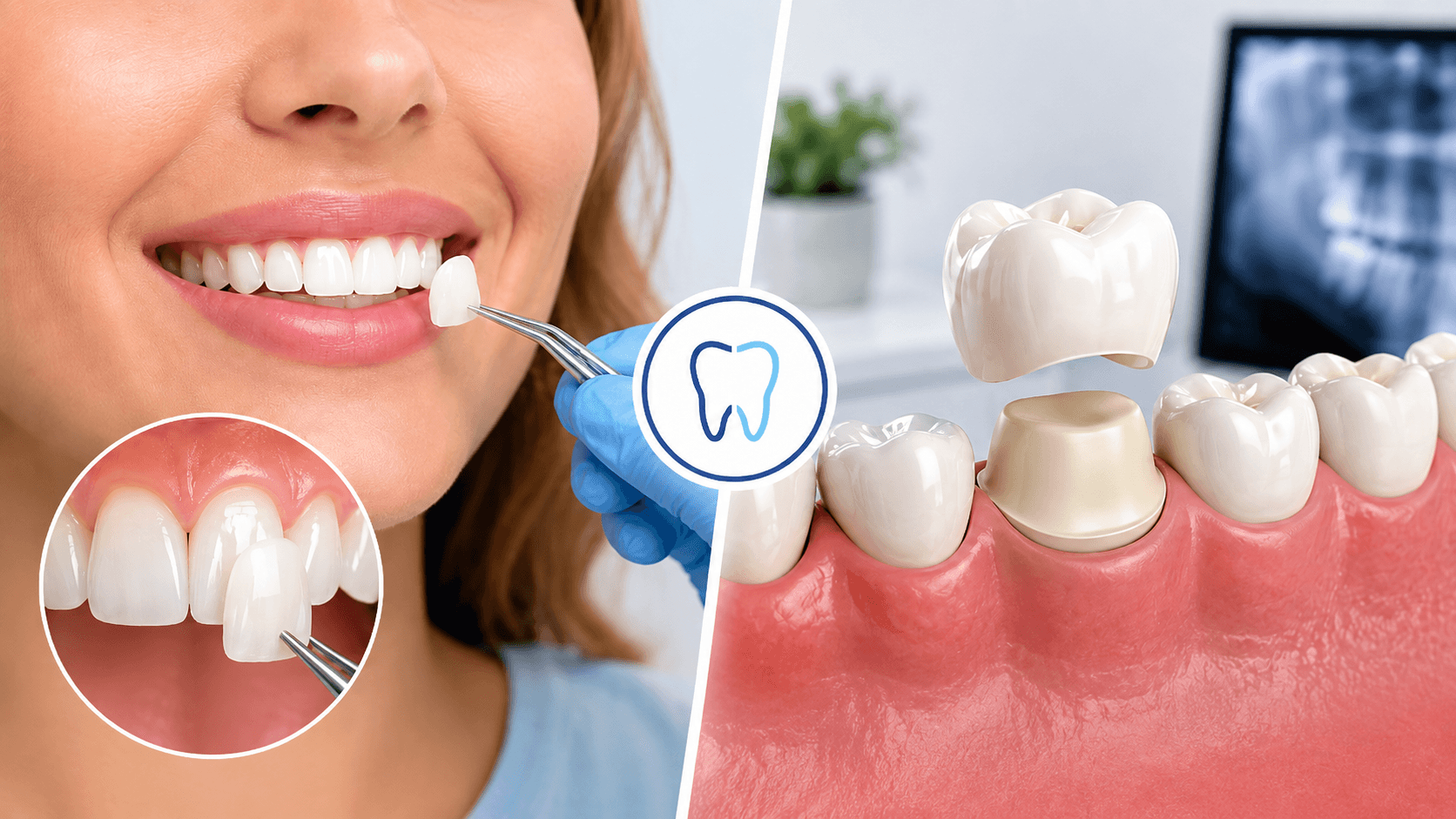
Veneers vs. Crowns: Which Cosmetic Option Is Right for You?
Written By Kirti Chopra, DDS, FAGD
A chipped front tooth and a tooth with a failing filling may both need restorative or cosmetic attention, but they do not necessarily require the same treatment. Veneers primarily change the visible surface of a tooth. Crowns are designed to restore and protect a tooth that has lost more of its natural structure. Knowing the difference can help you avoid choosing more extensive treatment than necessary, or selecting a restoration that may not be appropriate for the condition of the tooth.
At Smile Design Studio by KC in Rittenhouse Square, Philadelphia, Dr. Kirti Chopra, DDS, evaluates the condition, function, and remaining tooth structure before recommending whether a veneer, a crown, or a more conservative option may be appropriate
What Are Dental Veneers?
Veneers are thin shells, usually porcelain or composite resin, bonded to the front surface of a tooth. Preparing a tooth for a veneer typically involves removing a small, conservative layer of enamel, just enough for the shell to sit flush and look natural next to your other teeth.
Veneers are most often used to correct color that doesn’t respond well to whitening, close small gaps, adjust the shape of a tooth, or soften the look of minor crowding along the front teeth. Because so little of the natural tooth is altered, veneers work best on teeth that are structurally sound to begin with. Patients who want an even more conservative option, with little to no enamel removal, can ask about Bioclear during a consultation as an alternative for some cases.
Porcelain veneers tend to hold their color and resist staining better over time, while composite resin veneers can often be placed in a single visit and adjusted more easily if a repair is ever needed. Which material makes sense depends on how many teeth are involved, your bite, and how much of a single-visit turnaround matters to you.
Veneers · Bioclear · Cosmetic Bonding
What Are Dental Crowns?
A crown caps the entire visible portion of a tooth above the gumline. Crowns are made from materials like porcelain, lithium disilicate, zirconia, or a metal-ceramic combination, chosen based on the tooth’s location and the bite forces it needs to withstand.
Crowns are typically recommended after a root canal, for a tooth with a large or failing filling, for a fracture that affects a significant portion of the tooth, or when decay has removed too much structure for a filling alone to hold up. Because a crown needs to fit over the entire tooth, it requires more reshaping of the natural tooth than a veneer does.
Zirconia and porcelain-fused-to-metal crowns are common choices for molars, where bite force is highest, while all-ceramic crowns are often favored for front teeth because they blend more closely with the surrounding enamel. Dr. Chopra weighs strength against appearance based on where the tooth sits in your mouth.
The Middle Ground: Onlays and Partial Coverage
Veneers and crowns are not the only two options, and the space between them is where a lot of teeth actually belong.
An onlay covers one or more cusps of a tooth while leaving the rest of the natural structure intact. A table-top restoration rebuilds a worn biting surface without wrapping the tooth. Both are bonded rather than cemented over a fully reshaped tooth, which means a tooth that is too compromised for a veneer does not automatically require a full crown.
This matters most in cases of wear. Teeth that have flattened or shortened over years of grinding often need their biting surface and vertical height rebuilt, but the tooth itself may be otherwise sound. Reducing that tooth for full-coverage crowns removes healthy structure that a partial-coverage restoration would have preserved.
Whether partial coverage will hold up depends on how much sound tooth remains, how the bite loads that tooth, and what is causing the damage in the first place. That last question is the one worth answering before any restoration is chosen; a restoration placed without addressing the cause tends to fail the same way the tooth did.
Full Mouth Rehabilitation · TMJ & Joint Analysis
Key Differences at a Glance
| Feature | Veneers | Onlays / Partial Coverage | Crowns |
| Coverage | Front surface only | One or more cusps or the biting surface | Entire tooth, all sides |
| Tooth preparation | Minimal enamel removal | Moderate, limited to damaged areas | More substantial reshaping |
| Best for | Color, shape, minor spacing on healthy teeth | Worn biting surfaces, partial damage, failed large fillings | Decay, root-canal-treated teeth, structural damage |
| Longevity | Can last 10–15 years with consistent care | Comparable to crowns when well-planned | Often a similar range or longer, depending on material and bite force |
| Natural tooth preserved | Most of the original tooth kept intact | Healthy walls and cusps preserved | More structure removed permanently |
| Common materials | Porcelain, composite resin | Lithium disilicate, composite, zirconia | Porcelain, lithium disilicate, zirconia, metal-ceramic |
When to Consider Veneers
Veneers tend to be the right call when the tooth underneath is healthy, and the issue is purely cosmetic, persistent discoloration, a small chip, a slightly uneven edge, or a gap you’d like closed. If an exam confirms there’s no significant decay or old restoration compromising the tooth, a veneer gives you a natural-looking result while preserving most of the tooth’s original structure.
When to Consider Crowns
Crowns make more sense once a tooth has lost meaningful structure and the damage extends around the tooth rather than across one surface, a root-canal-treated tooth, a fracture running below the gumline, or decay that has undermined multiple walls. In these cases, neither a veneer nor a partial-coverage restoration has enough sound tooth to bond to. A crown reinforces the entire tooth, which is why it remains the right answer when function and durability matter as much as appearance.
Caring for Veneers and Crowns After Treatment
Day-to-day care is similar for both: brushing, flossing, and routine checkups protect the restoration and the tooth underneath it the same way they protect any other tooth. The differences show up around what each option can’t tolerate as well.
Veneers are bonded to the front of the tooth, so biting directly into very hard foods, ice, or hard candy, or using your front teeth to open packaging can chip the edge over time. A nightguard is often recommended for patients who grind their teeth, since that habit is one of the more common reasons a veneer needs an early repair.
Crowns are built to withstand more force, which is part of why they’re chosen for teeth that already needed structural reinforcement. The main risk is at the margin where the crown meets the gumline. Keeping that area clean helps prevent decay from developing underneath the crown, which is easy to miss without regular checkups.
What Determines the Cost of Veneers and Crowns
Cost depends on the material used, the number of teeth being treated, and the complexity of the case, so no single price applies to every patient.
For general orientation, published national averages put porcelain veneers at roughly $900 to $2,500 per tooth, and crowns at roughly $800 to $3,000 per tooth depending on material. These are national figures rather than Philadelphia figures, and they are not a quote. Patients who want a location-specific estimate before scheduling can look up dental costs by procedure and ZIP code through FAIR Health Consumer, an independent nonprofit cost-transparency database.
At Smile Design Studio by KC in Rittenhouse Square, the exact cost is determined during a consultation, once the tooth has been evaluated and treatment goals discussed. Financing options, FSA and HSA payments, and a membership plan are available.
Patient Information · Membership Plan
Frequently Asked Questions
Are veneers or crowns better for a chipped tooth?
It depends on the size and location of the chip. A small chip on an otherwise healthy tooth is often a good candidate for a veneer, or for bonding. A chip that involves a cusp or the biting surface may be better served by an onlay. A fracture affecting a significant portion of the tooth may need a crown for adequate support.
Do veneers damage your natural teeth?
Veneers require removing a thin, conservative layer of enamel so the shell can sit flush against the tooth. This step is permanent, which is why veneers are recommended only after confirming the tooth doesn’t need the fuller coverage a crown or onlay provides.
Is there an option between a veneer and a crown?
Yes. Onlays and partial-coverage restorations rebuild the damaged portion of a tooth while leaving sound structure intact. They are frequently appropriate for worn or partially damaged teeth that don’t require full coverage.
How long does getting a veneer or crown take?
Both typically involve two visits: one to prepare the tooth and take an impression, and a second to bond the finished restoration. Timelines can vary based on your treatment plan and whether any preparatory work is needed first.
Can a veneer be placed over a tooth that already has a crown?
Generally, no. Veneers bond to natural tooth enamel, and a crowned tooth is already covered in restorative material. In that situation, replacing the crown is usually the more appropriate option.
Will dental insurance cover veneers or crowns?
Veneers are usually considered cosmetic and are less likely to be covered. Crowns placed for a functional reason, such as after a root canal or to repair a fracture, are more commonly eligible for coverage. Check with your plan for specifics.
How will I know which option is right for my tooth?
The clearest way is a consultation and exam, which shows how much natural tooth structure remains and what it needs to function well long-term. That evaluation, not the size of the visible flaw alone, is what determines which restoration fits.
The Bottom Line
Veneers, onlays, and crowns aren’t competing versions of the same treatment. They’re built for different starting points: one for a tooth that’s healthy and just needs a cosmetic adjustment, one for a tooth that has lost part of its structure but not all of it, and one for a tooth that needs to be rebuilt and protected in full. Knowing which category your tooth falls into is what actually answers the question in the title, not a general preference for one option over another.
Schedule a Consultation
To find out which option fits your tooth, schedule a consultation with Kirti Chopra, DDS, at Smile Design Studio by KC- 255 S. 17th Street, Suite 2507, in Rittenhouse Square, Philadelphia. Call 215-545-4024 or request an appointment online.