
Written By Kirti Chopra, DDS, FAGD
A missing tooth is rarely a self-contained problem, and it is rarely as urgent as the internet suggests. Both of those things are true at once, which is why general advice about it tends to be useless. What follows is what actually changes after a tooth is lost, what the published evidence says about each way of replacing it, and how long you realistically have to decide.
What Actually Changes After a Tooth is Lost
Two separate things start to move, and they move on different clocks. Understanding which one you are racing is most of the decision.
The bone changes first, and fastest
When a tooth comes out, the bone that held it begins to remodel. A systematic review pooling human studies of extraction sites found that the ridge lost roughly 29 to 63 percent of its width and 11 to 22 percent of its height within six months, with most of that change occurring in the first three to six months (Tan et al., Clinical Oral Implants Research, 2012).
Note what that describes. It is not a slow thinning that plays out over decades. It is a dimensional change: the ridge becomes narrower and shorter, and it happens early. This matters because an implant needs a certain volume of bone in a certain position, and a site that would have accepted an implant comfortably at three months may need grafting first at three years.
The teeth move second, and less predictably
Neighbouring teeth can tip toward the space, and the tooth opposing the gap can drift down or up into it. How fast, and whether at all, depends on your bite, your age, and whether the surrounding teeth still have contacts holding them where they are.
This part is genuinely individual. Some people lose a lower molar and look essentially unchanged a decade later. Others show meaningful movement within a year. Anyone who tells you your teeth will definitely shift is overstating it, and anyone who tells you they will not is guessing. An examination, ideally with a record of where things sit now, is what turns that into an answer.
How Long Can You Wait?
This is usually the real question, and it does have an answer: the bone decision is more time-sensitive than the tooth-position decision.
If an implant is on the table at all, the useful window for deciding is measured in months rather than years.
That is because the ridge changes most in the first six months. Waiting longer does not rule an implant out. It more often means grafting becomes part of the plan, which adds a procedure, healing time, and cost.
If you already know an implant is not the direction, the timeline loosens considerably and is driven by your bite rather than the calendar. There is no clock running on a bridge or a partial denture in the way there is on bone volume.
So the first thing worth establishing is not which option you want. It is which of those two situations you are in.
Dental Implants
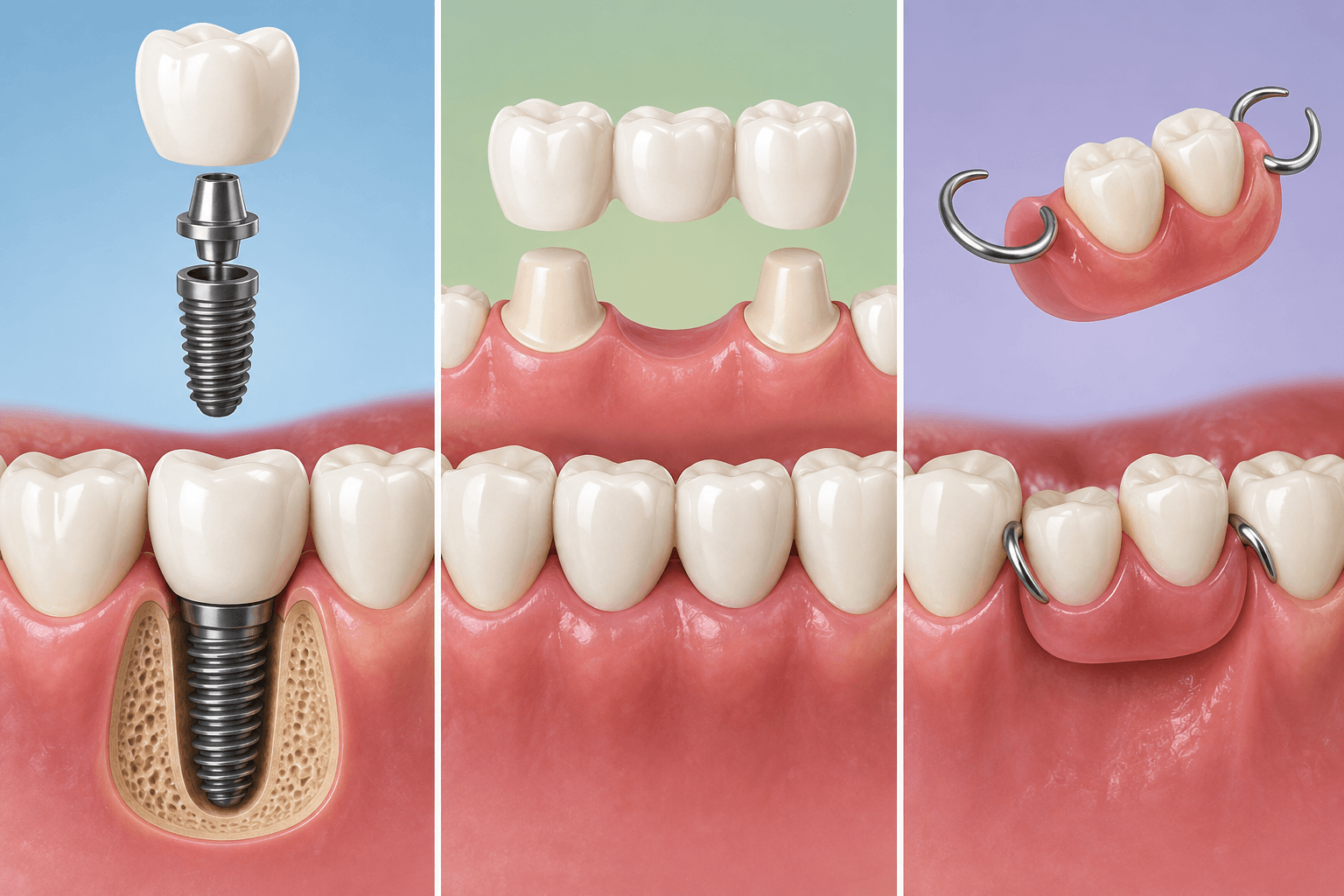
An implant replaces the root of the missing tooth with a small post placed into the jawbone. Over a healing period, the bone integrates with the surface of that post, and a crown is then attached to it. Of the four options here, it is the only one that replaces the root rather than spanning or covering the space.
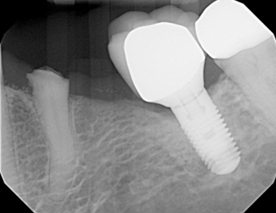
Treatment site before implant placement
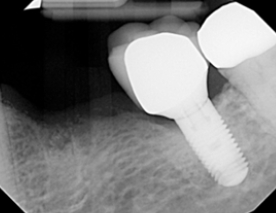
Treatment site after the healing period
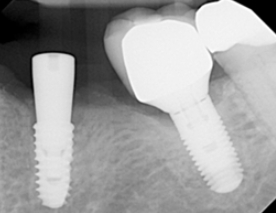
Implant positioned at the prepared site
A treatment sequence from my practice in Rittenhouse Square. The restored implant toward the right of each image is the same tooth throughout, which is what makes the three comparable. Radiographs taken at separate visits differ in angulation and exposure, so they show the sequence of treatment rather than a measurement of bone change. Individual results vary.The long-term data are good. A systematic review and meta-analysis of ten-year outcomes reported 96.4 percent implant survival (95% CI 95.2–97.5). A sensitivity analysis in the same paper, correcting for patients lost to follow-up and missing data, produced a more conservative 93.2 percent (Howe, Keys & Richards, Journal of Dentistry, 2019). I quote the lower figure as well as the higher one because it is the more realistic number to plan around, and because survival in that analysis fell with age, to 91.5 percent in patients aged 65 and over.
One distinction worth making, because it is often blurred: survival means the implant is still in place. It does not mean nothing ever needed attention. Inflammation of the tissue around an implant, a loosened screw, a chipped or fractured crown- these are more common than outright failure, and they are part of an honest conversation about what owning an implant involves over twenty years.
Whether a particular site is a good candidate depends on the volume and position of bone available, the health of the surrounding gum tissue, smoking, how well any diabetes is controlled, certain medications that affect bone metabolism, and how heavily your bite loads that area. An examination and imaging are what answer that. No one can answer it from a photograph or a description.
Conventional Fixed Bridges
A conventional bridge replaces the missing tooth with a crown suspended between the two teeth on either side of the gap, which are reshaped to carry it. There is no surgery, and the whole thing typically takes a few weeks rather than several months.
The cost is that the neighbouring teeth are permanently reduced. If those teeth are intact and healthy, that is real and irreversible; you are altering two sound teeth to solve a problem with a third.
But that tradeoff largely disappears in one common situation, and it is the most useful thing to know about bridges: if a neighbouring tooth is already heavily restored, cracked, or needs a crown anyway, a bridge is using teeth that were going to be covered regardless. In that case, you are not sacrificing anything you would otherwise have kept. The same treatment that looked like a compromise on two healthy teeth becomes the efficient answer.
A bridge does not address the ridge, since nothing replaces the root. Cleaning beneath the span requires a floss threader or a water flosser rather than ordinary flossing. And because the whole unit is joined, a problem developing under one supporting tooth generally means the entire bridge has to come off, which is worth knowing at the outset rather than at year twelve.
The Resin-Bonded (Maryland) Bridge
This option is often left out of the comparison, which is unfortunate, because for the right case it is the least destructive fixed option available.
A resin-bonded bridge carries the replacement tooth on a thin wing, increasingly a single wing rather than two, bonded to the back surface of an adjacent tooth. Preparation of that tooth is minimal, and in some cases there is none at all. Nothing is cut down to a stump.
It suits front teeth better than back ones, works best on neighbours with sound enamel to bond to, and asks for a bite that does not load the area heavily in side-to-side or protrusive movement. Its usual failure is debonding, which is generally re-bondable rather than terminal.
What makes it worth asking about specifically is that it keeps future options open. Because so little tooth structure is removed, a resin-bonded bridge can serve as a long-term interim, in a younger patient whose jaw growth is not finished, for instance, where an implant would be premature, without foreclosing anything. It can also be a definitive restoration in a well-selected adult case. If minimally invasive treatment matters to you, this is the option to raise, because it is not always offered.
Removable Partial Dentures
A removable partial denture replaces one or more missing teeth with a prosthesis that clips into place and comes out daily for cleaning. It is the lowest-cost option of the four, involves no surgery, and requires no reshaping of the adjacent teeth.
It is not, however, entirely neutral toward those teeth. The clasps rest on them. That means more plaque accumulation around the clasped teeth, and in some designs, forces applied in directions those teeth were not built to take. This is manageable with good hygiene and periodic review, but it is worth stating plainly rather than describing a partial denture as not affecting the neighbours.
A partial is strongest when several teeth need replacing at once, when cost is the binding constraint, or as a deliberate interim while a longer plan is staged. It asks for more day-to-day upkeep than anything fixed, and most people find it takes a few weeks to stop noticing it.
When leaving the space alone is a reasonable choice
Not every gap needs filling, and it is worth saying so.
A second molar lost with nothing above or below it to over-erupt into the space may not need replacing at all. A stable bite, with no functional difficulty and no aesthetic concern, may reasonably be monitored rather than treated. And a space is sometimes left deliberately while other treatment is sequenced ahead of it.
The distinction that matters is between a decision and a default. Choosing not to replace a tooth, with a record of where things stand and an interval to look again, is a plan. Not getting round to it is not, and it is how a site that had straightforward options at six months ends up needing a graft at four years.
Implant, Bridge, Maryland Bridge, and Partial Denture compared
How the four ways to replace a single missing tooth compare
| Implant | Conventional bridge | Maryland bridge | Removable partial | |
| Replaces the tooth root | Yes | No | No | No |
| Surgery involved | Yes | No | No | No |
| Effect on neighbouring teeth | None | Both reshaped to carry the bridge | Minimal, a wing bonded to enamel, often no preparation | Clasps rest on them; more plaque, and some designs apply load |
| Fixed or removable | Fixed | Fixed | Fixed | Removable |
| Addresses ridge at the site | Yes, replaces the root | No | No | No |
| Typical time to complete | Several months, including healing | Weeks | Weeks | Weeks |
| Daily care | Brushed and flossed like a natural tooth | Floss threader or water flosser under the span | Brushed and flossed normally | Removed daily and cleaned |
| Relative cost | Highest | Moderate | Lower | Lowest |
| Most common problem | Inflammation around the implant; screw or crown complications | Decay or fracture at a supporting tooth | Debonding, usually re-bondable | Wear, breakage, need for relining |
Who plans the implant, and who places it
Patients rarely know to ask this, and it shapes the whole experience, so it is worth being direct about how it works in my practice.
Implant treatment has two distinct parts: the surgical placement of the post, and the planning and restoration around it, deciding where the implant needs to sit, what the crown has to look like, and how the bite will load it. Those two parts do not have to sit with the same person, and they frequently do not.
I handle both, case by case. Straightforward sites with adequate bone I place and restore in-house. Complex sites, significant grafting, proximity to important anatomy, cases where a surgical colleague’s judgement genuinely improves the outcome: I plan and restore, and refer the placement to a surgeon I work with. The planning and the final result stay with me either way, which is the part that determines whether the implant looks right and holds up under your bite.
I am a general dentist, not a specialist in oral surgery, periodontics, or prosthodontics. That is worth stating plainly. What it means in practice is that I will tell you when a case belongs with a surgeon, and I would rather have that conversation at the planning stage than partway through.
Why the bite comes before the gap
There is a version of this treatment where you look at the space, place something in it, and call it finished. It works often enough that it remains common. It also produces a specific category of problem I see referred to me.
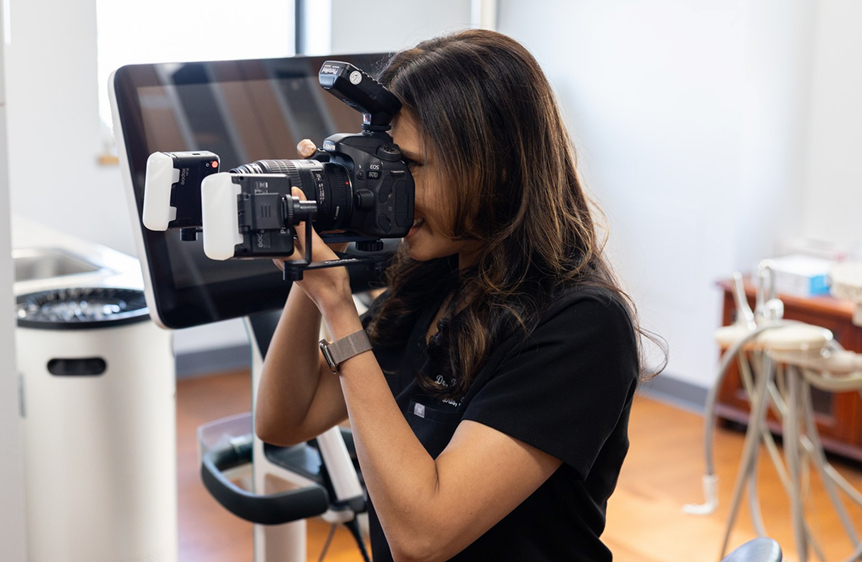
Records first. Photographs, imaging, and a bite assessment come before any decision about how to fill the space.
An implant does not have a periodontal ligament. A natural tooth sits in a ligament that acts as a shock absorber and, importantly, as a sensor, which is why you can feel a grain of sand between your teeth. An implant is fused directly to bone. It does not move, and it does not report back the same way. Put one into a bite that is already overloading that area, and the force that used to be shared and sensed now arrives somewhere with no give in it.
The same reasoning applies to appearance. A single implant crown placed without reference to the teeth around it can be technically successful and still look wrong: the wrong width, the wrong length, the gum sitting at the wrong height relative to its neighbours.
So before I plan a replacement, I want to know what the rest of the mouth is doing: how the teeth come together, whether there is wear or fracturing that suggests the bite is already carrying more than it should, what the gum tissue and bone look like at the site, and where the replacement needs to sit to look like it belongs. That is the difference between filling a space and replacing a tooth. It is also how I approach comprehensive treatment planning generally.
What determines the cost
Cost depends on how many teeth are being replaced, whether additional procedures such as bone grafting are needed first, which option fits the case, and the materials involved.
For general orientation, published national averages put a single-tooth implant including the crown at roughly $3,000 to $6,000. That is a national figure, not a Philadelphia one, and I would not want it read as a quote. For an estimate tied to your own area, FAIR Health Consumer, an independent nonprofit that publishes cost data by procedure and ZIP code, is the most reliable public source. Bridges typically fall below implants, and removable partial dentures below bridges.
Your actual cost is determined at a consultation, once the case has been examined. Financing, FSA and HSA payment, and a membership plan for patients without insurance are all available.
On insurance: coverage for implants varies more than for almost any other procedure. Some plans contribute meaningfully, some cover the crown but not the implant, and some exclude it entirely. Checking directly with your plan is the only way to know which applies to you.
What a Consultation Involves
A full examination and imaging to evaluate the bone at the site, the health of the surrounding tissue, and how the space relates to your bite and to the teeth around it. From there, a conversation about which of these options fits, including, where it applies, the option of not replacing the tooth, with a realistic timeline and a clear account of what each path involves.
Candidacy and healing depend on factors specific to each person, so nothing is promised in advance of that examination. What I can tell you beforehand is what I am looking at and why.
Frequently Asked Questions
How long can I wait before replacing a missing tooth?
If you want to keep an implant on the table, months rather than years, the ridge loses most of its width and height in the first six months after extraction. If an implant is already ruled out, the timeline is looser and depends on your bite rather than the calendar. Waiting past six months does not usually rule out an implant, but it makes grafting more likely.
Is a bridge or an implant better for me?
It depends most on the condition of the teeth on either side of the gap. If those teeth are intact and healthy, a bridge means permanently reducing two sound teeth, and an implant avoids that. If one of them already has a large filling, a crack, or needs a crown anyway, the argument for a bridge is much stronger; you are not sacrificing anything you would have kept.
Am I a good candidate for a dental implant?
Candidacy depends on the volume and position of bone at the site, gum health, smoking, control of any diabetes, certain medications affecting bone, and how your bite loads that area. An examination and imaging can answer it. A site that is not ready today can often be made ready; that is what grafting is for, so “not yet” is a more common answer than “no.”
What happens if I never replace it?
Possibly very little, and possibly quite a lot. The bone at the site narrows and shortens over the first six months regardless. Whether the neighbouring and opposing teeth move enough to matter varies considerably between people. For some sites, a second molar with nothing opposing it, for example, leaving it alone is a legitimate plan. An examination is what distinguishes a stable situation from one that is actively changing.
What is a Maryland bridge, and why has no one mentioned it?
It is a resin-bonded bridge: the replacement tooth is carried on a thin wing bonded to the back of an adjacent tooth, with minimal or no preparation of that tooth. It is not offered universally because it suits a narrower range of cases: front teeth, sound enamel, a bite that does not load the area heavily. Where it does fit, it is the least destructive fixed option, and it keeps future choices open. Worth asking about directly.
How long do dental implants last?
Pooled ten-year data reports 96.4 percent survival, and 93.2 percent in a sensitivity analysis correcting for missing follow-up. Survival means the implant is still in place; it does not mean nothing needed attention along the way. Complications such as inflammation around the implant, screw loosening, or a fractured crown are more common than outright failure.
Do you place implants yourself?
Case by case. Straightforward sites I place and restore in my Rittenhouse Square practice. Complex cases, significant grafting, or anywhere a surgeon’s judgement improves the outcome, I plan and restore, with placement referred to a surgical colleague. The planning and the final restoration stay with me either way.
Are removable partial dentures a reasonable long-term option?
For some people, yes, particularly when several teeth need replacing at once, or when cost or avoiding surgery is the deciding factor. They ask for more daily upkeep than anything fixed, and the clasps do rest on the adjacent teeth, which need attention to hygiene. Whether that trade works depends on your situation and on what you are willing to manage day to day.
The Bottom Line
Four options solve the same problem in different ways, and none of them is automatically right. An implant replaces the root and leaves the neighbouring teeth untouched, at the cost of surgery and healing time. A conventional bridge is faster and avoids surgery, but reduces two teeth, a real cost if they are healthy, and much less of one if they needed work anyway.
A Maryland bridge is the least destructive fixed option where the case suits it. A partial denture avoids surgery and cost, and asks more of you daily. And in some situations, monitoring a stable space is a sound decision rather than an avoided one.
Which one fits depends on your bite, on the condition of your bone and gums, and on how this tooth sits within everything else going on in your mouth, not on a general preference for one approach over another. The one thing worth doing early, whichever way you lean, is finding out which of those two clocks is running.
Talk It Through
If you are weighing these options, a consultation is where the question gets answered for your specific case, your bite, your bone, and what you actually want.
Kirti Chopra, DDS, FAGD, is a general dentist practising in Rittenhouse Square, Center City Philadelphia, with a focus on cosmetic and comprehensive dentistry. She earned her DDS at the Indiana University School of Dentistry, where she was inducted into Omicron Kappa Upsilon, and graduated with honors from the Kois Center. She holds a Fellowship in the Academy of General Dentistry and is an AACD Accreditation Candidate, having passed the written examination. Colleagues refer her cases involving worn dentition, failing restorations, bite problems, and aesthetic concerns.
Full background and credentials · Smile Design Studio by KC, 255 S. 17th Street, Suite 2507, Philadelphia, PA 19103 · 215-545-4024
REFERENCES
- Tan WL, Wong TL, Wong MC, Lang NP. A systematic review of post-extractional alveolar hard and soft tissue dimensional changes in humans. Clinical Oral Implants Research. 2012;23(Suppl 5):1–21. PubMed
- Howe MS, Keys W, Richards D. Long-term (10-year) dental implant survival: a systematic review and sensitivity meta-analysis. Journal of Dentistry. 2019;84:9–21. PubMed
- American Dental Association. MouthHealthy: Implants, Bridges, Partial dentures.
- FAIR Health, Inc. FAIR Health Consumer — dental cost lookup.