
Black Triangles Between Teeth: What Causes Them, and Why a Veneer Isn’t Always the Answer
Written By Kirti Chopra, DDS, FAGD
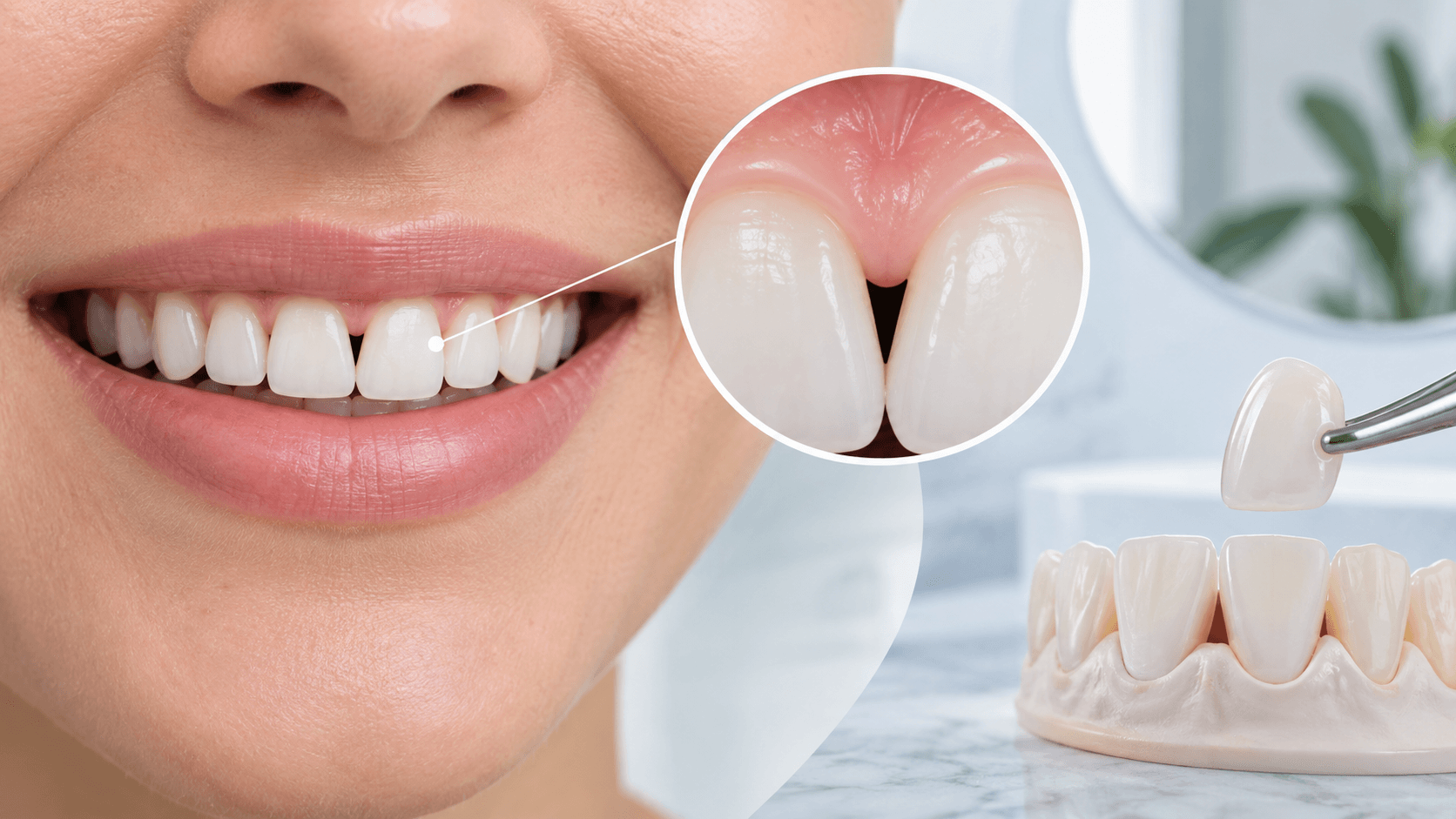
Patients almost always describe it the same way: two dark wedges that appeared between the front teeth, usually noticed in a photograph. Sometimes it follows braces or aligners. Sometimes it comes on gradually with no event to point at.
What makes black triangles frustrating is that they don’t respond to the things people try first. They aren’t stains, so whitening does nothing. They aren’t decay. They aren’t spacing that closes with more orthodontics. Orthodontics is one of the ways they appear in the first place. And the reflex fix, a set of veneers, means preparing healthy teeth to solve a problem that sits at the gumline.
It’s worth understanding what’s actually happening before deciding what to do about it.
What a Black Triangle Actually Is
The clinical term is an open gingival embrasure. The triangular space is bounded by two teeth on the sides and by the gum tissue between them, the interdental papilla, at its base.
Whether that papilla fills the space is largely a matter of geometry. In a 1992 study that still governs how this is assessed, Dennis Tarnow and colleagues measured the distance from the contact point where two teeth touch down to the crest of the bone between them. Where that distance was 5 mm or less, the papilla filled the space essentially every time. At 6 mm, it filled roughly half the time. At 7 mm, about a quarter.
Several things push that measurement past 5 mm:
- Bone loss from gum disease. The bone recedes, the papilla follows it down, and the contact point stays where it was.
- Tooth shape. Triangular crowns, narrow at the gumline and wide at the biting edge, place the contact point higher and leave a wider space beneath it. Square-shaped teeth rarely have this problem.
- Root divergence. Roots angled apart from each other leave more space between them than the papilla can fill.
- Thin gum tissue. A thin biotype has less volume to work with and recedes more readily.
- Age. Papilla height decreases over time even in healthy mouths.
- Orthodontic movement. Aligning crowded teeth uncrowds the contact points. Tissue that was compressed between overlapping teeth does not necessarily rebound to fill the corrected space.
The orthodontic connection, including clear aligners
This deserves its own paragraph, because it is the most common way patients arrive at the question.
Across studies of adult orthodontic patients, open gingival embrasures between the upper central incisors have been reported in roughly 22% to 42% of cases. A 2023 retrospective cohort comparing appliance types found the incidence higher after clear aligner treatment than after fixed braces, 35% versus 18% in the upper arch, and 38% versus 24% in the lower, with the resulting spaces measurably larger.
That is not an argument against aligners. Crowded teeth were concealing the underlying anatomy, not protecting it, and the conditions that make a black triangle likely, including thin tissue, triangular crowns, and prior bone loss, are present before treatment begins. It is an argument for identifying the risk during orthodontic planning, when interproximal reduction can be used to reshape contact points during treatment rather than restoring the space afterward.
Black Triangles Aren’t Only a Cosmetic Problem
Most patients raise them for appearance. There is a second reason to take them seriously: an open embrasure traps food and holds plaque in a spot that is awkward to clean. Floss passes through the space without contacting its walls. Over time, that can contribute to the same tissue loss that opened the space to begin with.
This does not mean every black triangle needs treatment. A small space in a healthy, stable mouth with good hygiene can reasonably be watched. But “purely cosmetic” isn’t quite right either, and it is part of why the decision deserves an examination rather than a photograph.
The Full Range of Options, Least Invasive First
- Monitoring. For a small space in a stable mouth with no food impaction, doing nothing is a legitimate plan.
- Hygiene changes. Interdental brushes sized to the space clean it considerably better than floss does.
- Orthodontics with interproximal reduction. Reshaping the adjacent surfaces lowers the contact point toward the bone. Useful when the teeth need moving anyway, but not as a standalone fix.
- Injection-molded composite (the Bioclear Method). Rebuilds the tooth’s contour down to meet the papilla. Additive rather than subtractive.
- Porcelain veneers. Full facial coverage. Closes black triangles as a by-product of changing the whole tooth.
- Gum grafting or surgical papilla reconstruction. Attempts to rebuild the tissue itself. Technically demanding, less predictable than restorative approaches, and generally reserved for cases where the tissue defect is the dominant problem.
- Crowns. Appropriate when a tooth has already lost substantial structure to decay, fracture, or a large old restoration, not as a black triangle treatment in its own right.
The useful question is not “Bioclear or veneers.” It is how far down this list a particular tooth actually needs to go.
What the Bioclear Method Does Differently
Composite has been used to close black triangles for decades, with a reputation for staining at the margins and dropping out. What changed is technique rather than concept:
- The matrix wraps below the gumline. A conventional strip matrix is flat and sits between the teeth. The Bioclear matrix is anatomically curved and extends subgingivally, so the restoration can be shaped where the space actually is instead of stopping at the tissue level.
- The surface is prepared by air abrasion rather than a bur. Aluminum oxide particles clean biofilm and the outer surface layer off the enamel to give the adhesive a clean substrate, without cutting the tooth.
- Heated composite is injected rather than layered by hand. Warming lowers the viscosity so the material flows into the matrix as a single mass, which limits the voids and layering lines that cause staining and marginal breakdown.
- The finish is a defined polishing sequence, not a quick pass with a disc. Surface smoothness is a major determinant of whether a composite stains.
The evidence base is young, and it is more honest to say so than to imply otherwise. A 2023 randomized clinical trial in BMC Oral Health compared black triangle closure using the Bioclear matrix against the conventional celluloid strip technique in 26 patients over twelve months.
The Bioclear group showed significantly better marginal integrity at every interval; anatomical form, patient-reported phonetics, and food impaction were equally successful in both groups. The authors’ own conclusion is worth quoting: both techniques were “almost equally successful; however, they are depending on the operator skills.”
That is a fair summary of where things stand. The matrix system makes a difficult restoration more predictable at the margin. It does not make the result operator-independent.
Bioclear vs. Veneers
Injection-molded composite (Bioclear) | Porcelain veneers | |
What happens to the tooth | Additive. The surface is air-abraded and etched, but the tooth is not reduced | Subtractive. Roughly 0.3 to 0.7 mm of facial enamel is prepared away, less in minimal-prep designs |
Material | Heated composite resin, placed and shaped chairside | Porcelain, fabricated in a lab or milled chairside, then bonded |
Visits | Usually one | Usually two: prepare and temporize, then bond |
Stain resistance | Composite picks up stain over time; periodic polishing manages it | Porcelain does not stain; the bonded margin can |
If it chips | Repaired directly, usually in a single appointment | Sometimes repairable with composite; often replaced |
What it cannot do | Large color changes or major shape changes across a full smile | Little, if the tooth can support the preparation |
Future options | Tooth is unprepared, so veneers or crowns remain available later | Once enamel is removed, the tooth requires a restoration permanently |
Best suited to | Black triangles, small gaps, chipped or worn edges, contour corrections | Comprehensive changes in color, shape, and alignment across several teeth |
Why the Enamel Question Isn’t Just Philosophy
There is a practical reason, not only a conservative one, to leave enamel alone where possible.
Veneer longevity depends heavily on what the porcelain is bonded to. A systematic review and meta-analysis of feldspathic porcelain veneers reported 5-year survival of 95.7%, with a 10-year estimate approaching 95.6%, and attributed that durability specifically to bonding to enamel. Preparations that cut through enamel into dentin bond less reliably.
So preserving enamel is not only about keeping options open. It is about preserving the substrate that any future restoration will need to bond to. Every fraction of a millimeter removed today is enamel the next restoration will not have.
How Long Does Each One Last?
This is where patients usually get a vague answer, so here are the actual figures with the caveats they deserve.
For direct anterior composite restorations, a systematic review covering 1,821 restorations across 17 studies reported annual failure rates ranging from 0% to 4.1%, and survival rates from 53.4% to 100%. That spread is wide because it spans many materials, techniques, and operators across decades. Fracture was the most common reason for failure; where restorations had been placed for cosmetic reasons, aesthetic failures, including staining, color mismatch, and contour, came next.
For porcelain veneers, the figures above are roughly 95% at five years, and close to that at ten on the available data.
Two honest caveats. Neither figure is specific to injection-molded composite for black triangles, because the technique is newer than most of the studies. And the largest single variable in either number is not the material. It is whether the patient grinds, what they bite into, and how consistently the restoration is maintained.
What This Approach Can’t Fix
A conservative option is only the right option when it can actually meet the goal.
- Teeth needing a substantial color change across the smile. Composite can be matched to the teeth beside it; it cannot lighten a whole arch the way veneers combined with whitening can.
- Teeth that have lost significant structure to decay, fracture, or a large existing filling. Those need an onlay or crown for strength, not a contour correction.
- Severe crowding or rotation. Adding material to a badly misaligned tooth makes it bulkier, not straighter. Orthodontics comes first.
- Active gum disease. Nothing restorative belongs in inflamed, unstable tissue. Treat that first and reassess. Sometimes the tissue response alone changes the plan.
Maintenance: the Part Usually Left Out
Composite is a maintainable material, which is both its advantage and its obligation.
Expect periodic polishing, usually at hygiene visits, to keep the surface smooth. Expect coffee, tea, red wine, and tobacco to affect composite more than porcelain. Expect a nightguard to matter more if you grind, because composite handles that load differently than porcelain does.
None of this is a reason to choose porcelain instead. It is a reason to know what you are choosing.
What It Costs
Cosmetic dental fees vary widely by region, by the number of teeth involved, and by how much reshaping each one needs, so any single figure is misleading. As a national reference point, published consumer data puts dental bonding at an average of $431 per tooth, within a typical range of $288 to $915. Those are national figures, not local ones.
Two things follow. This work is billed per tooth rather than as a package, so a two-tooth black triangle closure and a six-tooth reshaping are not comparable quotes. And because it is usually classified as cosmetic, dental insurance frequently will not cover it. Restoring a chipped or fractured tooth is more likely to attract partial benefit than closing a space for appearance.
For an estimate tied to a specific ZIP code, FAIR Health Consumer publishes a free dental cost lookup. An exact fee still requires an examination, because the number of surfaces involved is not something anyone can determine from a photograph.
Frequently Asked Questions
Can black triangles between teeth be fixed without surgery?
Yes, in most cases. Restorative approaches that rebuild the tooth’s contour, injection-molded composite in particular, close the space with no surgical procedure. Surgical papilla reconstruction exists, but it is technically demanding and less predictable, and is generally reserved for cases where the tissue defect itself is the primary problem.
Do black triangles go away on their own?
No. Once the papilla has receded below the contact point, it does not grow back on its own, and the space can widen over time if the underlying cause is not addressed. Improving hygiene helps stop it from worsening; it does not close what is already open.
Does Bioclear require drilling or removing enamel?
Typically not. The surface is cleaned with air abrasion and etched to prepare it for bonding, but the tooth is not reduced with a bur the way a veneer preparation requires. That is the main structural difference between the two approaches.
How long does Bioclear last?
Published data on injection-molded composite specifically is still limited, because the technique is relatively new. Direct anterior composite restorations more broadly have reported annual failure rates between 0% and 4.1%. In practice, longevity depends more on grinding habits, diet, and maintenance than on the material.
Is Bioclear better than veneers?
Neither is better in general; they address different problems. This approach corrects contour, including black triangles, small gaps, chips, and worn edges, on teeth that are otherwise healthy. Veneers change color and shape across multiple teeth and are the appropriate choice when the goal is comprehensive. Where both could reach the same result, the conservative option preserves more tooth structure.
How many teeth can be treated at once?
Multiple. Black triangles rarely occur in only one place, and several can usually be addressed in the same visit. The number affects appointment length and fee rather than feasibility.
Will dental insurance cover it?
Usually not, when the purpose is cosmetic. Treatment to restore a chipped or fractured tooth is more likely to receive partial benefit. Coverage varies by plan, so it is worth verifying before treatment.
Can black triangles appear after Invisalign or braces?
Yes. Orthodontic treatment is one of the more common circumstances in which they show up, and reported rates are higher after clear aligners than after fixed appliances. This reflects the tissue conditions that were present beforehand rather than a defect in the treatment. Raising it during orthodontic planning allows interproximal reduction to be considered during treatment, instead of restoration afterward.
The Decision
The useful question isn’t whether Bioclear is better than veneers. It is how far a particular tooth needs to be taken to reach the result you want, and whether the more conservative point on that scale gets you there.
Answering it means seeing the teeth: the size of the space, the shape of the crowns, the thickness and health of the tissue, and whether the bone underneath is stable. A photograph doesn’t show any of that.
Kirti Chopra, DDS, FAGD practices cosmetic and comprehensive dentistry in Rittenhouse Square, Philadelphia. She is a Kois Center Graduate with Honors, a Fellow of the Academy of General Dentistry, an AACD Accreditation Candidate, and has completed Bioclear Method training through the Bioclear Learning Center.
References
- Tarnow DP, et al. “The effect of the distance from the contact point to the crest of bone on the presence or absence of the interproximal dental papilla.” Journal of Periodontology, 1992.
https://pubmed.ncbi.nlm.nih.gov/1474471/ - “Management of gingival black triangles.” British Dental Journal, 2014.
https://www.nature.com/articles/sj.bdj.2014.1004 - “The incidence and severity of open gingival embrasures in adults treated with clear aligners and fixed appliances: a retrospective cohort study.” 2023.
https://pmc.ncbi.nlm.nih.gov/articles/PMC10351162/ - “Restoring black triangle with bioclear matrix versus conventional celluloid matrix method: a randomized clinical trial.” BMC Oral Health, 2023.
https://bmcoralhealth.biomedcentral.com/articles/10.1186/s12903-023-03102-y - “Anterior composite restorations: a systematic review on long-term survival and reasons for failure.” Dental Materials, 2015.
https://pubmed.ncbi.nlm.nih.gov/26303655/ - “A systematic review and meta-analysis of the survival of feldspathic porcelain veneers over 5 and 10 years.”
https://www.ncbi.nlm.nih.gov/books/NBK126506/ - CareCredit. “How much does teeth bonding cost?”
https://www.carecredit.com/well-u/health-wellness/teeth-bonding/ - FAIR Health Consumer, dental cost lookup.
https://www.fairhealthconsumer.org/dental