
(215) 545-4024
255 S. 17th Street, Suite 2507, Philadelphia, PA 19103
Monday- Friday
8:00 am- 5:00 pm.
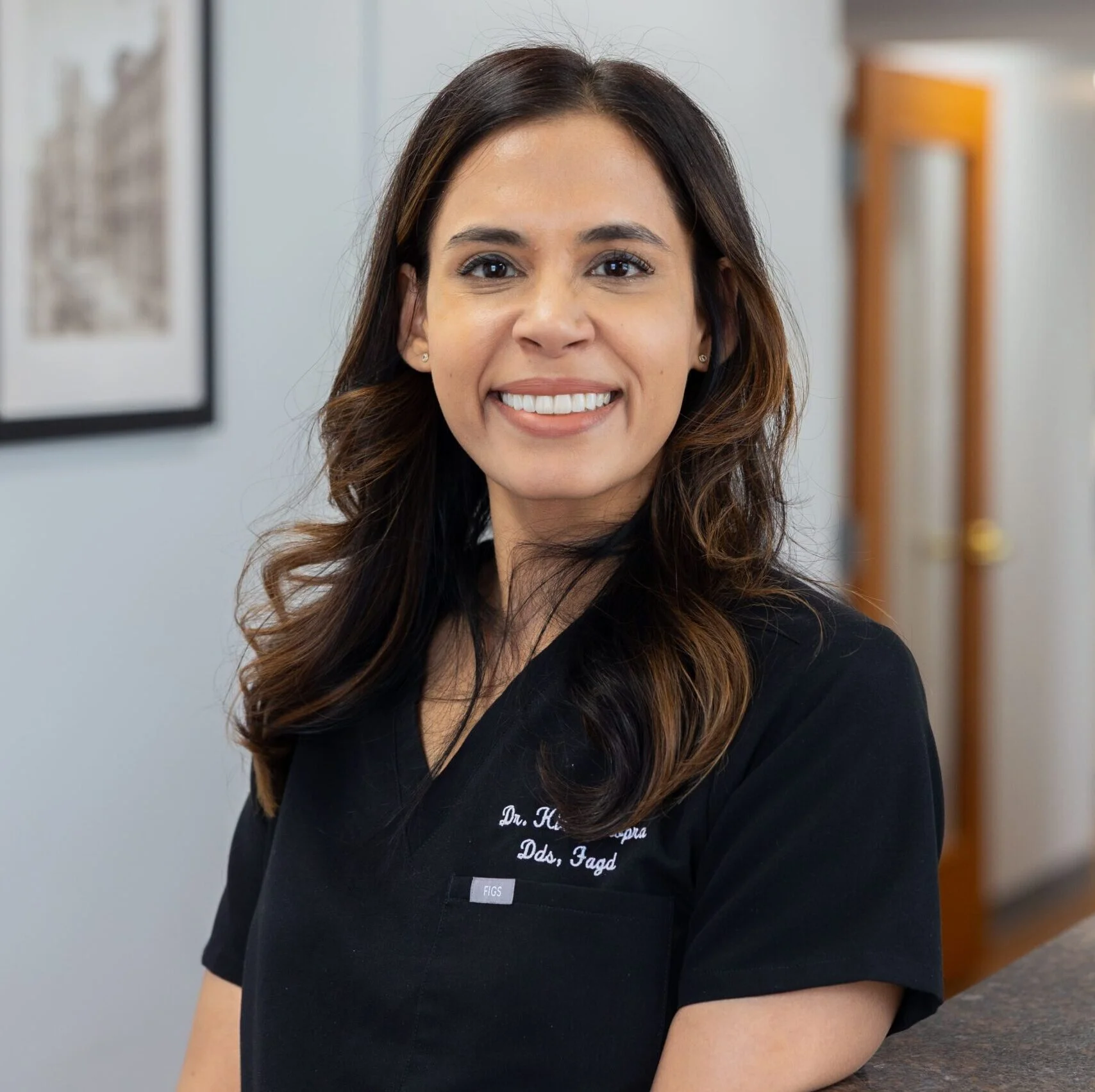
By Dr. Kirti Chopra, DDS, FAGD — General dentist, Smile Design Studio by KC, Rittenhouse Square, Center City Philadelphia · Kois Center Graduate with Honors.
A cosmetic consultation tends to surface the same worries, whether the concern is a chipped edge, a shade someone is unhappy with, or a smile that has changed over the years. Most of those worries are practical, not medical, which is exactly why they’re worth answering plainly rather than saving for the chair. Here are the questions I hear most.
People sometimes apologize for asking about something purely cosmetic, as if that makes it less legitimate. It’s worth pushing back on that. A 2021 systematic review of 33 studies found that how people see the appearance of their teeth and face has a measurable effect on their oral health-related quality of life (Larsson et al., The impact of oro-facial appearance on oral health-related quality of life: A systematic review, Journal of Oral Rehabilitation, 2021). So no, it isn’t only vanity. How your smile affects how you feel day to day is a legitimate reason to address it.
Most of what falls under cosmetic dentistry, such as whitening, bonding, and veneers, is done with local anesthesia when any tooth structure is involved, and some of it, like whitening, doesn’t require anesthesia at all. Tooth sensitivity is a known effect of whitening. A 2025 systematic review of 77 studies of at-home bleaching found it was mild on average across bleaching agents and concentrations, though higher concentrations raised both the risk and the intensity (Terra et al., Effect of at-home bleaching agents and concentrations on tooth sensitivity: A systematic review and network meta-analysis, Journal of Dentistry, 2025). I’d rather a patient know that upfront than assume the worst and put off a conversation about something that’s bothering them.
It depends heavily on which treatment we’re talking about, and I’d rather not give a single number that doesn’t apply evenly across bonding, veneers, and whitening, because it doesn’t.
What I can say generally is that longevity depends on the treatment and on habits such as grinding, which can shorten the life of a restoration (Loomans & Opdam, A guide to managing tooth wear: the Radboud philosophy, British Dental Journal, 2018). For the specific numbers behind veneers versus other options, I’ve written more detail in Veneers vs. Crowns: Kirti Chopra, DDS, on Which Cosmetic Option Is Right for You.
Usually not, when the primary purpose is appearance rather than function. Restoring a tooth that’s fractured or decayed is more likely to attract some benefit, even if the fix happens to also improve how it looks, but a procedure done purely for shade or shape is typically classified as elective. Coverage varies enough by plan that checking directly with your insurer before treatment is the only reliable way to know where you stand.
Cosmetic dentistry isn’t a recognized specialty. The American Dental Association’s National Commission on Recognition of Dental Specialties and Certifying Boards lists 12 recognized specialties, and cosmetic dentistry is not one of them (Recognized Dental Specialties).
It’s a description of the kind of work a general dentist chooses to focus on. That surprises people. I’ve written a fuller explanation of what that distinction actually means for evaluating a dentist in How to Choose a Cosmetic Dentist in Rittenhouse Square, but the short version is that the label itself doesn’t tell you much. Training does.
We can talk about what you want on day one, but I won’t recommend a specific treatment without an exam first. The reason is practical: the same visible concern, whether a gap, a chip, or a color you don’t like, can have more than one underlying cause, and the right fix depends on which one applies to you. Skipping that step doesn’t save time. It usually just means a second conversation later, once the first plan doesn’t hold up.
That first exam also tells me things a patient wouldn’t necessarily think to bring up themselves: how the bite is functioning, whether there’s any existing restorative work that changes what’s realistic, and whether the tooth in question is otherwise healthy enough to support the treatment being considered. None of that changes what you’re asking for. It just makes sure the plan actually gets you there.
It depends on how much of the natural tooth is altered, which varies by treatment and isn’t something I’d generalize across bonding, veneers, or more conservative options like Bioclear. Some approaches remove very little tooth structure and keep more options open later; others involve permanent preparation.
In a laboratory study of preparation designs on resin teeth, veneer preparations removed about 3 to 30 percent of the tooth’s crown structure, compared with about 63 to 72 percent for crowns (Edelhoff & Sorensen, Tooth structure removal associated with various preparation designs for anterior teeth, Journal of Prosthetic Dentistry, 2002).
I go through what a specific treatment does and doesn’t undo as part of every consultation, and I’ve written more about that distinction in Black Triangles Between Teeth, where it comes up directly.
Honestly, that’s what the consultation is for. I can’t answer it generally, because it depends on what’s causing the concern, how much of the tooth is sound to begin with, and what result you’re actually after. Sometimes the visible concern and its cause turn out to be different things, which is why the exam comes first.
Every cosmetic consultation with Dr. Chopra in Rittenhouse Square, Center City Philadelphia, begins with these same questions and a comprehensive exam before any treatment is proposed. Every patient is seen by Dr. Chopra personally. Dr. Kirti Chopra, DDS, FAGD, is a Fellow of the Academy of General Dentistry, a Kois Center Graduate with Honors, an AACD Accreditation Candidate who has passed the written examination, and was inducted into Omicron Kappa Upsilon in 2018.
Full background and credentials
View Dr. Chopra’s Professional Profile
Is cosmetic dentistry considered medically necessary?
Not usually, which is part of why insurance coverage is limited. That doesn’t make it unimportant. Appearance-related dental concerns have a documented effect on quality of life, but it does affect how treatment is classified for coverage purposes.
Can I get a cosmetic consultation without committing to treatment?
Yes. A consultation is where I explain the options and the reasoning behind them. Deciding whether to move forward comes after that conversation, not before it.
Does cosmetic dentistry include things like whitening, or only major procedures?
It covers the full range, from whitening and bonding to more involved procedures like veneers. What ties them together is the primary goal of appearance, not the size of the procedure.
Will cosmetic treatment look obviously done?
That’s a fair concern, and it’s part of why the exam and consultation matter. A plan built around your specific teeth and goals looks different from a one-size approach, which is generally what patients are reacting to when a result looks unnatural. Veneer patients see their result twice before any tooth is prepared: as a digital preview built from their scan and photographs, and as a trial smile tried in the mouth.
Can cosmetic dentistry address more than one concern at once?
Often, yes. A shade you dislike and a chipped edge can be part of the same plan, but the order of treatment matters, so I sequence it after the exam rather than before.
What should I bring to a cosmetic consultation?
Bring a short list of what bothers you about your smile, any photos of smiles you like, and any records or X-rays from a previous dentist. None of it is required, but it helps me understand what result you’re actually after.
What if I’m not sure what I want?
That’s a common place to start. Tell me what bothers you, or what you’d change if you could, and we work from there. Part of the consultation is showing you options you may not have considered.
Will I be pushed into treatment I don’t need?
No. If the most conservative option meets your goal, that’s the one I’ll recommend, and sometimes the right answer is to wait or to monitor. The exam tells me what’s actually causing the concern before I suggest anything.
To talk through your own questions, schedule a consultation with Dr. Kirti Chopra, DDS, at Smile Design Studio by KC. Call 215-545-4024 or request an appointment online.
Kirti Chopra, DDS, FAGD, is a general dentist practicing cosmetic and restorative dentistry at Smile Design Studio by KC in Rittenhouse Square, Center City Philadelphia. She earned her DDS at the Indiana University School of Dentistry, where she was inducted into Omicron Kappa Upsilon. She is a Fellow of the Academy of General Dentistry, a Kois Center Graduate with Honors, and an AACD Accreditation Candidate, having passed the written examination.
(215) 545-4024
255 S. 17th Street, Suite 2507, Philadelphia, PA 19103
Monday- Friday
8:00 am- 5:00 pm.
© 2026 Kirtichopra. All Rights Reserved.


