
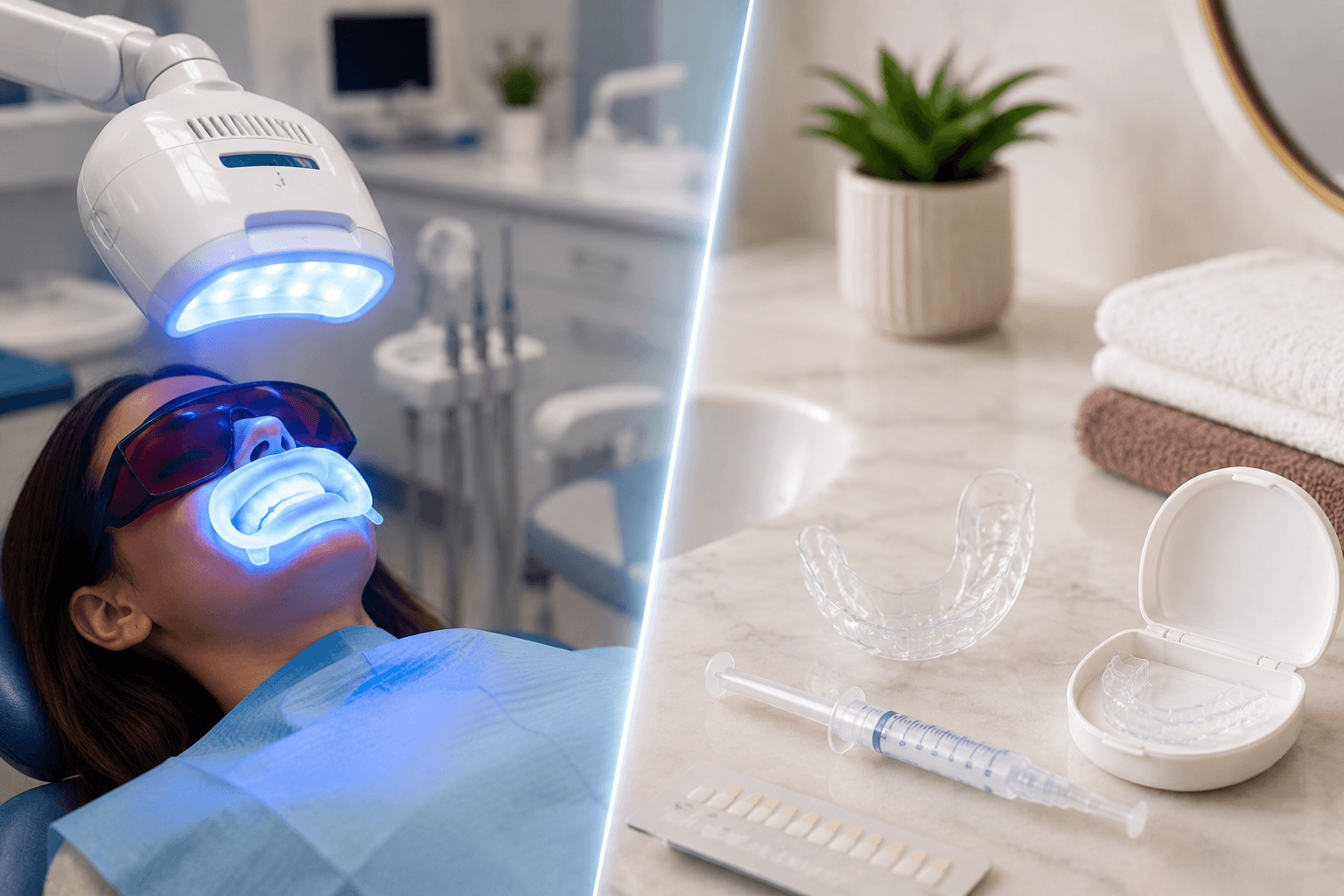
Professional Teeth Whitening vs. At-Home Kits
Written By Kirti Chopra, DDS, FAGD
Most drugstore products whiten: they remove stain from the outside surface of the tooth. Professional treatment bleaches: it penetrates the tooth and changes its internal color, which is where a tooth’s color actually lives. That is the real difference, and it is why strips can leave teeth looking cleaner without looking whiter. For light surface staining, an at-home product may be all you need. For anything deeper, an exam establishes what is causing the discoloration and how much change is realistically available, because every tooth has a maximum whiteness beyond which it will not go, no matter what is applied to it.
Drugstore shelves are full of whitening strips, pens, and toothpaste, and the appeal is obvious: cheap, convenient, no appointment. The gap between what they promise and what they deliver is where most of the disappointment comes from.
That gap is usually explained as a strength difference; professional gel is stronger. That is part of it. But the more useful explanation is that the two are doing different jobs, on different parts of the tooth.
“Whitening” and “Bleaching” are Not the Same Thing
The words get used interchangeably in advertising. Clinically, they mean different things.
Whitening products remove stain from the external surface of the tooth. Most whitening toothpastes work largely by abrasion, with surfactants, enzymes, and pyrophosphates that help break down the stained film on the tooth so brushing can lift it away.
Bleaching products penetrate the tooth structure and change its internal color. This matters because the color of a tooth is not in the enamel; enamel is largely translucent. The color lives in the dentin underneath it. Peroxide passes through both layers and changes the color of the dentin itself, as well as removing stain.
So a whitening toothpaste that removes six weeks of coffee film is doing real work. It is simply not the same work, and it cannot produce the same result.
Every Tooth has a Ceiling
This is the part most patients are never told. Each tooth has a maximum whiteness beyond which it will not go, regardless of the technique or the material used. Once a tooth has reached that point, a higher-concentration gel, a longer appointment, or another round of treatment makes no further difference to the color.
Teeth also do not all bleach at the same rate, and neither do patients. Ordinary age- and diet-related discoloration typically responds within a few days to about six weeks, with five weeks a fair average. Nicotine staining takes considerably longer.
Staining from tetracycline-family medications is the slowest of all, often three to four months, and sometimes up to a year, and how well it responds depends on the shade of the stain and where on the tooth it sits, with the area nearest the gumline the hardest to change because the dentin there is thicker and structurally different from the dentin toward the biting edge.
Knowing which of those you are is the difference between a realistic plan and an expensive disappointment.
What an Exam Establishes Before Whitening Starts
What is actually causing the discoloration
Surface stain, internal color, or something else entirely. A shade that reads unusually gray prompts questions about medical history; systemic minocycline, often prescribed long-term for acne, can cause a generalized gray discoloration of the permanent teeth, and the severity tends to track how long it was taken. That kind of discoloration behaves very differently from coffee and wine, and it changes the timeline and the expectation.
How translucent your teeth already are
Most teeth become more opaque as they bleach, which is part of why they read as whiter. But a tooth that is already translucent, common at thin, worn incisal edges, can become more translucent and never really look whiter, however the treatment goes. That is worth identifying before treatment, not after.
What existing dental work you have
Composite fillings, crowns, veneers, and bonding do not respond to bleaching agents at all. Beyond that, a filling on the tongue side of a front tooth can start to show through once the tooth becomes more translucent, and composites that currently blend well can end up mismatched once the surrounding tooth lightens. Both are far easier to plan for than to discover afterwards.
Your history with sensitivity
Peroxide travels through enamel and dentin to the pulp within minutes, and the temporary sensitivity some patients feel is a short-lived, reversible inflammation there. It is manageable, and it resolves, but a history of sensitivity, combined with frequent application at high concentration, is what drives it. Notably, cracks in the enamel are not in themselves a reason to avoid bleaching.
What is actually bothering you about how your teeth look
Sometimes shade is the problem. Sometimes what a patient is reacting to is tooth position, the amount of gum showing when they smile, or the shape of the teeth, and bleaching will not change any of those. Establishing what is really driving the concern prevents a patient from whitening, seeing little difference in how their smile reads, and concluding that whitening does not work.
How Professional Bleaching Works
The most effective option is not the most dramatic one. Custom-tray bleaching with a low-concentration carbamide peroxide gel, worn at home over a course of days or weeks, is the safest, most cost-effective, and most reliably effective approach available. The tray is made to fit your teeth, which is what keeps the gel in even contact with every surface, the thing a one-size strip cannot do.
In-office treatment has its place, particularly for difficult discoloration and for patients who want the process started quickly. Often the two are combined.
Two things worth knowing, because the marketing usually says otherwise:
- Light and laser “power” whitening speeds the process up; it does not produce a better long-term result. It does reliably increase sensitivity, and the light sources generate heat, which is its own consideration.
- More concentrated is not better. A lower concentration applied for longer, at a sensible frequency, produces as good a result with less sensitivity. Spacing applications out further is one of the simplest ways to keep a sensitive patient comfortable.
Treatment is also usually planned one arch at a time. Plenty of patients bleach the upper teeth, are happy with the result, and never treat the lower ones, which is worth knowing before you assume you are committing to the whole mouth.
How At-Home Products Work, and What the Research Shows
Strips, pens, pre-filled trays and whitening toothpaste use low concentrations formulated to be safe without supervision, and their contact time with the tooth is short. Both limit how much they can do.
Whitening toothpaste
More than half of over-the-counter whitening toothpastes rely on mechanical removal of the stained film, using a relatively high proportion of abrasives, sometimes combined with agents that break down that film chemically. They are measurably better than ordinary toothpaste at removing surface staining over about six weeks. What the research also shows is that this improvement does not reliably translate into a meaningful change in tooth color, and that patients often report a whiter smile even where objective measurement finds little real change.
Charcoal
Charcoal products are marketed on the idea that charcoal binds surface stain so brushing can carry it away. Studies comparing charcoal-based toothpastes with conventional toothpaste have found no advantage in reducing staining, and that whatever stain removal occurs is attributable mainly to the abrasion of brushing rather than to the charcoal. Loose charcoal powder is the more concerning form: it has been shown to roughen the enamel surface, reduce its gloss, and increase wear.
The part that gets skipped
Because these products require no prescription and no supervision, the risks sit entirely with the user: abrasion of enamel, increased surface roughness, reduced hardness, and reactions to ingredients. Used sensibly on light surface staining, or to maintain a professional result, they are a reasonable low-cost option. Used heavily, on teeth with existing sensitivity or extensive dental work, they are not.
Professional Bleaching vs. At-Home Products: The Differences that Matter
| PROFESSIONAL BLEACHING | AT-HOME PRODUCTS | |
| What it acts on | Penetrates the tooth and changes the color of the dentin, where tooth color lives | Mostly removes stain from the outer surface |
| Diagnosis first | Cause of discoloration, translucency, existing dental work and sensitivity history assessed before anything is applied | None — you assess yourself from the packaging |
| Fit | Custom tray holds gel evenly against every surface | Generic strips or one-size trays |
| Predictability | You know the likely ceiling and timeline before you start | You find out afterwards |
| Sensitivity | Anticipated from the exam; concentration and frequency adjusted | Left to the user to manage once it starts |
| Deeper discoloration | Can address it, with a realistic timeline set in advance | Generally cannot reach it |
| Upfront cost | Higher | Lower |
Sequencing: Whiten First, Then Wait Two Weeks
If any restorative work is planned- bonding, veneers, a new crown the order matters, and so does the pause between.
Teeth regress slightly from the shade they show immediately after treatment, so a final shade should not be assessed until roughly two weeks after bleaching finishes. Matching a new restoration before then means matching a color the tooth is not going to keep.
There is a second reason for the same two weeks. The strength of the bond between adhesive resin and freshly bleached enamel drops sharply straight after treatment, so bonded work is delayed to let it recover. Between the two, two weeks is the sensible interval: whiten, wait, then match and bond.
What Professional Whitening Costs
Tray bleaching is billed per arch, not per patient, which is why upper-only treatment is a real option rather than a compromise. Nationally, tray bleaching averages roughly $260 to $320 per arch, a figure that typically covers the examination, screening radiographs, impressions, the trays themselves, and the materials. That is a national average, not a Philadelphia quote.
For a location-specific estimate before scheduling, you can look up dental costs by procedure and ZIP code through FAIR Health Consumer, an independent nonprofit cost-transparency database.
At Smile Design Studio by KC in Rittenhouse Square, your exact cost is determined at a consultation, once your teeth have been evaluated and your goals discussed. Financing options, FSA and HSA payment, and a membership plan are available.
Patient Information · Membership Plan
Whitening at Smile Design Studio by KC in Rittenhouse Square
At Smile Design Studio by KC in Rittenhouse Square, Center City Philadelphia, Dr. Kirti Chopra, DDS, evaluates what is causing the discoloration, how your teeth are likely to respond, and what existing dental work will and won’t change with them, before recommending tray bleaching, in-office treatment, or a combination.
Teeth Whitening · Smile Makeovers · Smile Gallery
Frequently Asked Questions
How white can my teeth actually get?
Every tooth has a maximum whiteness beyond which it will not go, regardless of the material or technique used, and past that point, stronger gel or more sessions change nothing. Where your ceiling sits depends on your teeth. An exam is how you find out before you spend money rather than after.
Does charcoal toothpaste whiten teeth?
The research says no better than ordinary toothpaste. Studies comparing charcoal-based toothpastes with conventional ones have found no advantage in reducing staining, and that the stain removal that does occur comes mainly from the abrasion of brushing. Charcoal powder is worth more caution still; it has been shown to roughen the enamel surface, reduce its gloss, and increase wear.
Why didn’t my whitening strips work?
Usually because the discoloration was internal rather than on the surface. Strips act mostly on the outside of the tooth, and a tooth’s color lives in the dentin underneath the enamel. Fit is the other common reason; strips miss the areas between teeth and don’t hold gel evenly against every surface.
Is laser or light whitening better?
It’s faster, not better. Light and laser-accelerated bleaching speeds the process up but does not produce a better long-term result, and it does increase sensitivity. The light sources also generate heat, which is a separate consideration.
How long does whitening take?
Ordinary discoloration usually responds within a few days to about six weeks, five weeks being a fair average. Nicotine staining takes longer. Staining from tetracycline-family medications is slowest, often three to four months, sometimes as long as a year.
Why do my teeth look less white a couple of weeks later?
Some regression from the immediate post-treatment shade is normal. It’s also why a final shade isn’t assessed until about two weeks after treatment ends; that settled color is the one worth matching anything else to.
Can I whiten if my teeth are sensitive?
Usually yes, with adjustments. Sensitivity during bleaching is a temporary, reversible inflammation of the pulp caused by peroxide passing through the tooth, and it resolves. A history of sensitivity mainly changes the concentration and how often treatment is applied; spacing applications out is one of the simplest ways to stay comfortable.
I have small cracks in my front teeth. Can I still whiten?
Cracks in the enamel are not in themselves a reason to avoid bleaching. They are worth evaluating for other reasons, but they don’t rule it out.
Is there an age limit?
Bleaching is generally considered appropriate from around the age at which the permanent teeth have erupted, and there is no upper age limit.
Will whitening work on veneers or crowns?
No. Bleaching only changes natural tooth structure. Veneers, crowns, bonding, and composite fillings stay exactly the shade they are while the natural teeth around them lighten, which is why existing dental work is assessed before treatment, not after.
How long after whitening can I have bonding or veneers done?
About two weeks, for two reasons: the shade needs to settle so the restoration is matched to the color your teeth will actually keep, and the bond strength between adhesive and freshly bleached enamel needs time to recover.
Do I have to whiten both upper and lower teeth?
No. Treatment is usually planned one arch at a time, and it is billed per arch. Many patients treat the upper teeth, are happy with the result, and stop there.
The Bottom Line
At-home products and professional bleaching are not competing for the same result. One removes stain from the surface of the tooth, real work, worth doing, and enough on its own for light staining or for maintaining a result you already have. The other reaches the layer where a tooth’s color actually lives.
Which one fits depends on what is causing your discoloration and how much change is realistically available to you. Those are both answerable, but only by an exam, and not by a box.
Schedule a Consultation
To find out which whitening option fits your teeth, schedule a consultation with Dr. Kirti Chopra, DDS, at Smile Design Studio by KC, 255 S. 17th Street, Suite 2507, Philadelphia, PA 19103, in Rittenhouse Square, Center City.
Call 215-545-4024 or book online.