
(215) 545-4024
255 S. 17th Street, Suite 2507, Philadelphia, PA 19103
Monday- Friday
8:00 am- 5:00 pm.
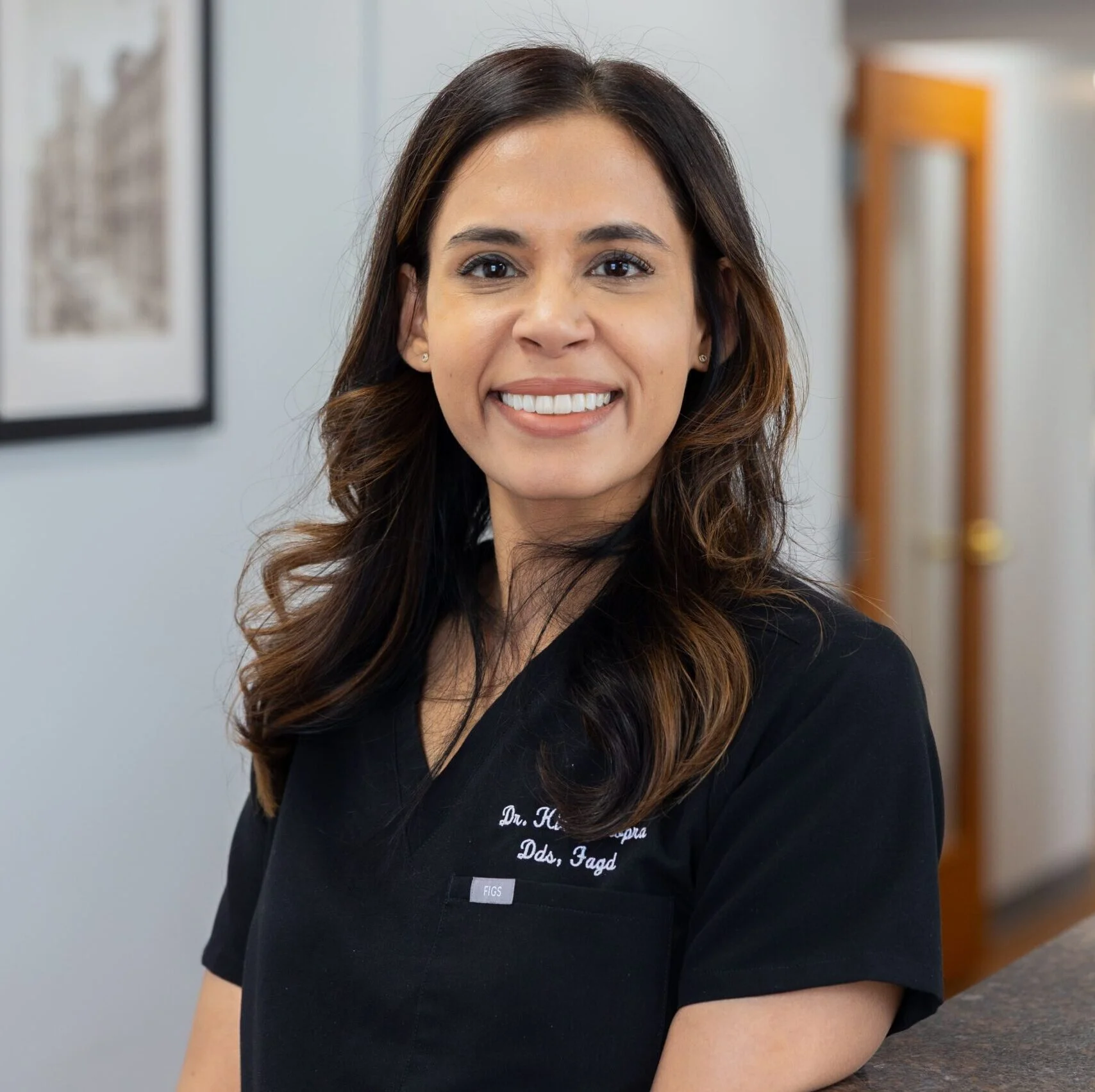
By Dr. Kirti Chopra, DDS, FAGD — General dentist, Smile Design Studio by KC, Rittenhouse Square, Center City Philadelphia · Kois Center Graduate with Honors.
Most people expect a new patient exam to be about their teeth. It is, but it’s rarely only that. The questions patients ask me most about that first visit are really questions about why the exam covers more ground than they expected, so I’ll answer them here in the order they usually come up.
I’m not looking at one tooth at a time. I’m looking at four things together: the teeth, the gums, the bite, and the airway. The order matters less than the fact that they’re evaluated as one system, not four separate checklists. Findings in one part of the mouth are easier to read alongside the others, so I’d rather see the whole picture before I say anything about any one part of it.
Because dentists are in a position to notice things most patients wouldn’t think to mention to a physician. The American Dental Association’s policy statement encourages dentists to screen for sleep-related breathing disorders as part of a comprehensive medical and dental history.
In practice, that means I ask about snoring, daytime sleepiness, choking, or pauses in breathing, and I note risk factors such as a recessed lower jaw, obesity, or high blood pressure. If risk is identified, the next step is a referral to a physician for diagnosis (American Dental Association, Policy Statement on the Role of Dentistry in the Treatment of Sleep Related Breathing Disorders, 2017, amended 2019).
To be clear about what this is and isn’t: it’s an airway screening, not a diagnosis. If something looks worth a closer look, that’s a reason to talk to a physician or a sleep specialist, not a finding I can diagnose from a dental chair.
A digital scan replaces the old putty impression, and it does more than make the visit more comfortable. It gives me a precise, three-dimensional record of exactly where your teeth and bite are on day one.
A systematic review comparing intraoral scanners with conventional impressions found that scanners can be used reliably for diagnostic purposes and short-span scanning, with more deviation on full-arch scans (Abduo & Elseyoufi, Accuracy of Intraoral Scanners: A Systematic Review of Influencing Factors, European Journal of Prosthodontics and Restorative Dentistry, 2018).
The other reason I take one at every new patient exam, not just when something needs treatment, is that it becomes the baseline. If something changes two years from now, I’m comparing it against your own records, not a general average.
The gum evaluation is a measured exam, not a look. I use a small probe to measure the depth of the pockets around each tooth and check whether the gums bleed; I measure attachment loss and recession, and I review your X-rays (American Academy of Periodontology, Diagnosis and Examination).
Those numbers tell me how the tissue is attached and whether anything is progressing. There’s no history to compare against yet at a first visit, so this exam becomes the reference point every future visit gets measured against.
Patients usually come in thinking about a tooth, or how their smile looks, and the bite doesn’t come up unless I bring it up. But how your teeth meet when you close is one of the things I look at when a tooth is wearing, chipping, or a restoration keeps needing attention. Tooth wear usually has more than one cause, typically grinding together with acid erosion, so the bite is one part of the picture (Loomans & Opdam, A guide to managing tooth wear: the Radboud philosophy, British Dental Journal, 2018).
I’d rather look at it at the first visit than after a filling has already failed once. For patients where several things are compounding at once, such as worn teeth, a shifting bite, and aging restorations, that’s a different scope of planning, closer to what full mouth rehabilitation is built to address than a single-tooth fix.
You get a plan, not a procedure. Once I’ve looked at the teeth, the gums, the bite, and the airway, and reviewed the scan, we talk through what I found and what, if anything, needs attention, and in what order. Not everything found at an exam needs treatment right away. Some things get monitored. The exam’s job is to give both of us an accurate starting point, not to generate a list of procedures.
Component | What’s Evaluated | Why It’s Part of the Exam |
Teeth | Decay, wear, existing restorations | Establishes the baseline condition of each tooth |
Gums | Pocket depths measured with a probe, bleeding, attachment loss, recession, X-rays | Gum health affects how restorative and cosmetic work holds up |
Bite | How the upper and lower teeth meet | Tooth wear usually has more than one cause, so the bite is evaluated alongside the others |
Airway | Snoring, daytime sleepiness, choking, or pauses in breathing; risk factors such as a recessed lower jaw, obesity, or high blood pressure; screening, not a diagnosis | Dentists are encouraged to screen as part of a comprehensive medical and dental history and to refer to a physician for diagnosis |
Digital scan (iTero) | Precise 3D record of teeth and bite | Creates the personal baseline future visits are compared against |
What does a new patient exam cover at Smile Design Studio by KC?
I evaluate four things together: your teeth, your gums, your bite, and your airway. Every new patient also gets an iTero digital scan at that first visit.
Does every new patient get an iTero scan, or only patients who need treatment?
Every new patient. It’s part of the standard new patient exam, not something I add later once treatment is planned.
Is the iTero scan uncomfortable?
No. There’s no putty or impression tray. A small handheld scanner is passed over your teeth to build a digital record, and most patients find it easier than the old method.
Is the airway check a sleep apnea diagnosis?
No. It’s a screening for signs worth mentioning, not a diagnosis. If I see something worth a closer look, I’ll suggest you talk to a physician or sleep specialist, because diagnosing a sleep-related breathing disorder requires medical evaluation.
Will I be told I need treatment at my first visit?
Not necessarily. The exam’s purpose is an accurate starting point. Some findings I monitor rather than treat right away, and what happens next depends on what the exam and scan actually show.
What should I bring to my first visit?
Bring your insurance card if you have one, a list of your current medications, and any recent X-rays or records from a previous dentist. If you can have those sent ahead, it helps me avoid repeating anything unnecessarily.
I only came in about one tooth. Will the exam still cover everything?
Yes. Every new patient exam follows the same four-part evaluation regardless of what brought you in, because the tooth that’s bothering you is often connected to something else in the mouth.
Why does the bite matter if my teeth look fine?
Because how your teeth meet is one of several things that can contribute to wear or to a restoration needing repeated attention, and it can be worth knowing before anything is visible. Tooth wear usually has more than one cause, so I look at the bite alongside the others rather than on its own.
How long does a new patient exam take?
It varies by case, since a comprehensive exam covering four areas plus a digital scan takes longer than checking one tooth. Scheduling can give you a more specific estimate.
What if I’m nervous about going to the dentist?
That’s common, and it’s a good reason to tell me at the start. Every patient is seen by me personally, so I explain what I’m doing as I go, and we move at a pace that works for you.
Every new patient exam at Dr. Kirti Chopra’s clinic in Rittenhouse Square, Center City Philadelphia, follows the same four-part evaluation: teeth, gums, bite, and airway, plus an iTero digital scan, regardless of what brought you in. Every patient is seen by Dr. Chopra personally, allowing the evaluation and treatment planning to remain consistent from the initial exam onward.
Full background and credentials
View Dr. Chopra’s Professional Profile
To schedule your own new patient exam with Dr. Kirti Chopra, DDS, FAGD at Smile Design Studio by KC, call 215-545-4024 or request an appointment online.
Kirti Chopra, DDS, FAGD, is a general dentist practicing cosmetic and restorative dentistry at Smile Design Studio by KC in Rittenhouse Square, Center City Philadelphia. She earned her DDS at the Indiana University School of Dentistry, where she was inducted into Omicron Kappa Upsilon. She is a Fellow of the Academy of General Dentistry, a Kois Center Graduate with Honors, and an AACD Accreditation Candidate, having passed the written examination.
(215) 545-4024
255 S. 17th Street, Suite 2507, Philadelphia, PA 19103
Monday- Friday
8:00 am- 5:00 pm.
© 2026 Kirtichopra. All Rights Reserved.


