
(215) 545-4024
255 S. 17th Street, Suite 2507, Philadelphia, PA 19103
Monday- Friday
8:00 am- 5:00 pm.
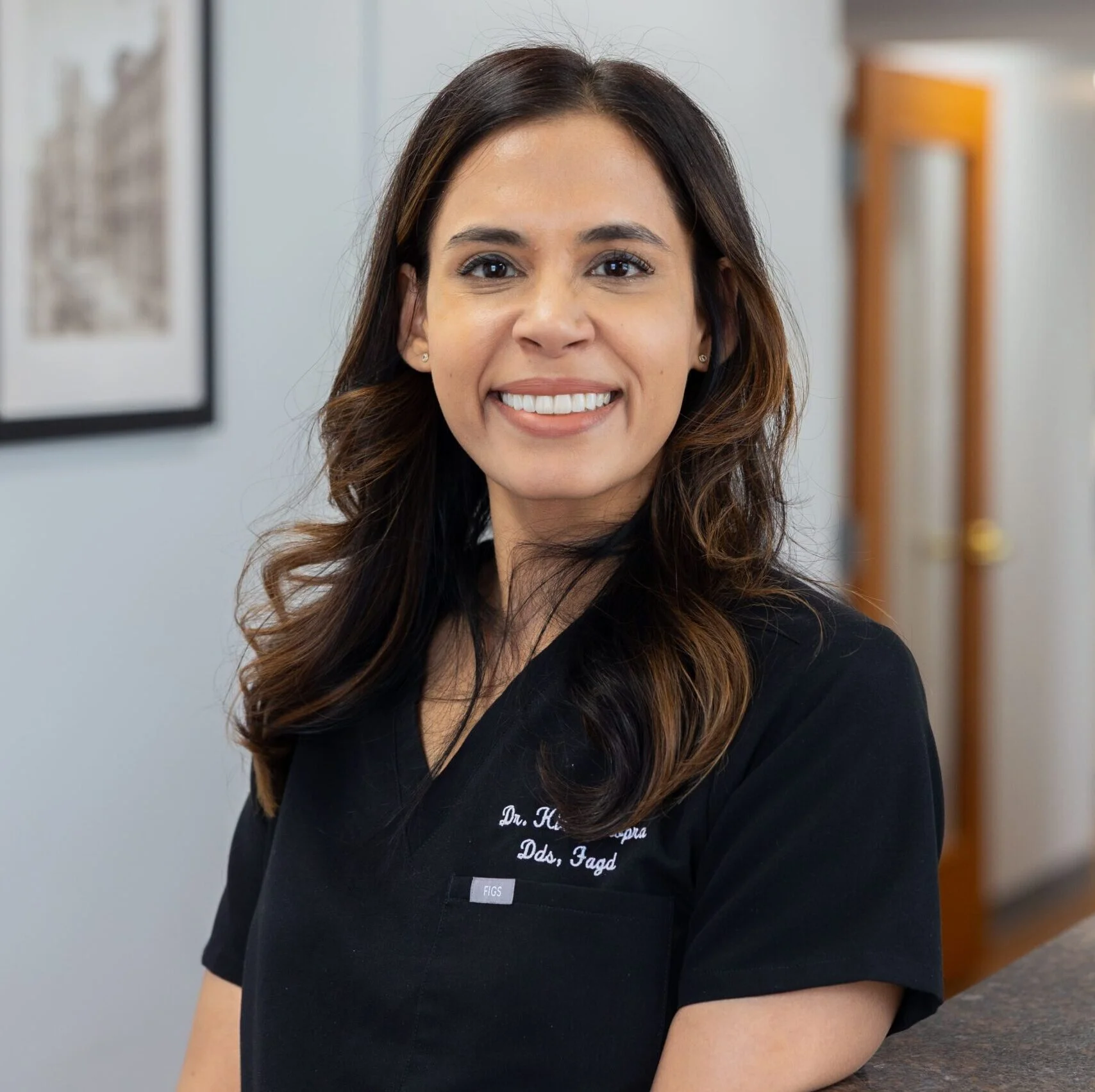
By Kirti Chopra, DDS, FAGD — General dentist, Smile Design Studio by KC, Rittenhouse Square, Center City Philadelphia · Kois Center Graduate with Honors
Most patients expect a dentist to check their teeth and are surprised by how much of my attention goes to the tissue around them. Gums rarely hurt until a problem is well along, so what I can see and measure at an exam is often the only early information there is. That is why the gum evaluation is its own step in every exam I do, alongside the teeth, the bite, and the airway.
The probe is still considered the instrument of choice for assessing the health of the gum tissues at the time of an exam. I use a small probe to measure the depth of the pocket around each tooth. I also check whether the gums bleed when probed, which remains an integral part of a routine exam, and the probe lets me measure attachment loss, which reflects the history of attachment up to the point of the exam (American Academy of Periodontology, Diagnosis and Examination).
No single number settles anything. A pocket depth, a spot that bleeds, and an amount of attachment loss each mean more when I read them together, and when I can compare them with the same measurements from your last visit.
I also measure how far the gumline has pulled back from where it started. Gingival recession is highly prevalent, and it is often associated with sensitivity, with decay and wear on the exposed root surface, and with changes in how the smile looks (Jepsen et al., Periodontal manifestations of systemic diseases and developmental and acquired conditions: Consensus report of workgroup 3 of the 2017 World Workshop, Journal of Periodontology, 2018). Recording exactly where each gumline sits today means that a change next year is something I can measure rather than something I have to remember.
Gumline changes can also affect how a smile looks, and black triangles between teeth are one example I have written about separately.
A probe only reaches so far. When X-rays are needed, they are an important component of a gum evaluation (American Academy of Periodontology, Diagnosis and Examination), and I review them alongside the measurements. Whether they are needed is a clinical decision, not a routine.
The ADA and FDA guidelines say dentists should order radiographs only when they expect the additional diagnostic information to affect patient care (American Dental Association and U.S. Food and Drug Administration, The Selection of Patients for Dental Radiographic Examinations, revised 2012). If you have recent X-rays from another office, bring them or have them sent, so nothing is repeated that does not need to be.
At a first visit, there is no history to compare against, so what I record becomes the reference point every future exam is measured against. An iTero digital scan is taken at every new-patient comprehensive exam, which gives me a record of your teeth and bite on day one as well. Every patient is seen by me personally, so the same person is comparing each visit against the last.
Periodontitis is an inflammatory condition that is irreversible once it has developed. It is also preventable, and treatment is associated with reduced rates of tooth loss and improved quality of life (Chapple et al., Primary prevention of periodontitis: managing gingivitis, Journal of Clinical Periodontology, 2015). That is the reason I would rather notice a change early than late. I do not diagnose anything from one number, and what the findings mean is a conversation we have after the whole exam, not during it.
What I record | What it shows | Why it is in the exam |
Pocket depths, measured with a probe | The space between the gum and each tooth | Gives me numbers to compare across visits |
Bleeding on probing | Whether the gums bleed when probed | An integral part of a routine exam |
Attachment loss | The history of attachment up to the day of the exam | Shows where things stand, not just how they look |
Recession | Where each gumline sits today | Gives me a reference point for future change |
X-rays, when they are needed | What the probe cannot reach | Part of a gum evaluation when they are clinically needed |
Some findings are monitored, and some call for treatment. When the exam shows that gum tissue needs more than routine care, I explain the options, including the option of waiting and watching, and the order in which things would happen. That care is gum disease treatment at Smile Design Studio by KC in Rittenhouse Square, Center City Philadelphia, and it starts only after we have gone through what I found.
Gum health also connects to general health, and I have covered where the evidence is strong and where it is not in what a dental exam can and cannot tell you about your health.
Does the gum evaluation hurt?
Probing can be uncomfortable if your gums are inflamed or tender, and I would rather you tell me than tough it out. I adjust as I go.
Does bleeding during probing mean something is wrong?
Bleeding is a sign of inflammation, but one bleeding spot predicts little on its own. In a study of patients in gum maintenance care, sites that bled repeatedly went on to lose attachment only 6% of the time, while sites that consistently did not bleed stayed stable 98% of the time (Lang et al., Absence of bleeding on probing. An indicator of periodontal stability, Journal of Clinical Periodontology, 1990). That is why I read bleeding together with the other measurements instead of on its own.
Will I need X-rays at my first visit?
Not necessarily. X-rays are taken when they are clinically needed, not at every exam. If you have recent X-rays from a previous dentist, bring them or have them sent, and I will review what you have before deciding what else is needed.
Do you check my gums even if I only came in about one tooth?
Yes. Every new-patient exam covers the teeth, gums, bite, and airway, regardless of what brought you in.
How often are my gums measured?
At every exam. How often you come in depends on your own history, and we set that interval together.
What is gum disease treatment?
It is the care that follows when an exam shows your gum tissue needs more than routine cleaning. What it involves depends on what I find, and I explain the options, including monitoring, before anything starts.
Why not just look at my gums instead of measuring them?
Because a look cannot give me numbers to compare. Measurements taken the same way at each visit are what let me tell whether something is stable or changing.
To schedule an exam with me at Smile Design Studio by KC, call 215-545-4024 or request an appointment online.
Kirti Chopra, DDS, FAGD, is a general dentist and the owner of Smile Design Studio by KC in Rittenhouse Square, Center City Philadelphia. She earned her DDS from Indiana University School of Dentistry, where she was inducted into Omicron Kappa Upsilon, the national dental honor society, in 2018. She is a Fellow of the Academy of General Dentistry, a Kois Center Graduate with Honors, and an AACD Accreditation Candidate, written examination passed. She completed Bioclear Method training at the Bioclear Learning Center.
About Dr. Kirti Chopra at Smile Design Studio by KC · About Dr. Kirti Chopra on kirtichopra.com
Kirti Chopra, DDS, FAGD, is a general dentist practicing cosmetic and restorative dentistry at Smile Design Studio by KC in Rittenhouse Square, Center City Philadelphia. She earned her DDS at the Indiana University School of Dentistry, where she was inducted into Omicron Kappa Upsilon. She is a Fellow of the Academy of General Dentistry, a Kois Center Graduate with Honors, and an AACD Accreditation Candidate, having passed the written examination.
(215) 545-4024
255 S. 17th Street, Suite 2507, Philadelphia, PA 19103
Monday- Friday
8:00 am- 5:00 pm.
© 2026 Kirtichopra. All Rights Reserved.


