
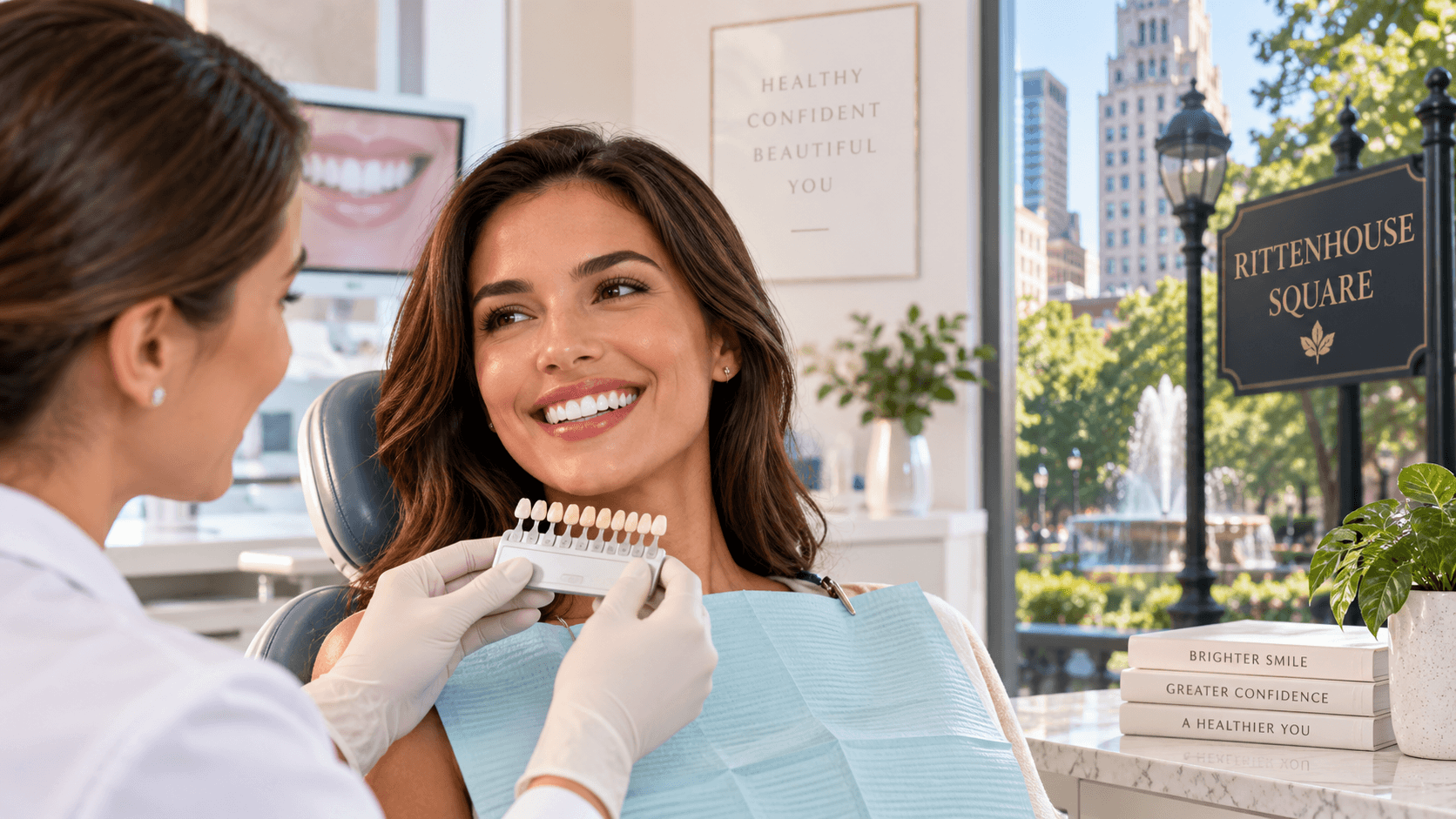
Finding a Cosmetic Dentist in Rittenhouse Square
Written By Kirti Chopra, DDS, FAGD
“Cosmetic Dentist” Is a Description, Not a Specialty
This is the first thing worth knowing, and it is not widely understood.
The American Dental Association recognizes a specific list of dental specialties – orthodontics, periodontics, oral surgery, endodontics, and others. Cosmetic dentistry is not among them. There is no cosmetic residency, no specialty board, and no restriction on the term. It is a description of the work a general dentist chooses to focus on.
That is not a criticism of the term; it is an accurate account of what it means. And it has a practical consequence: because the label itself is not regulated, it carries no information about training. What does carry information is the postgraduate education a particular dentist has completed, all of which is voluntary and all of which is verifiable.
What a Cosmetic Evaluation Covers
A cosmetic concern almost always has more than one possible cause, and the cause determines which treatment will last.
A gap between two front teeth can be a size discrepancy between the teeth themselves, a difference between tooth size and jaw size, a periodontal change, or a consequence of how the teeth are meeting. A chipped edge can be an accident, or it can be the visible end of a wear pattern that will chip the repair too. A shade you dislike can be surface staining, internal discoloration, an old restoration that no longer matches, or thinning enamel showing the dentin underneath. The right treatment is different in each case, and you cannot tell them apart by looking at the tooth in isolation.
So a cosmetic evaluation looks at the teeth, the gums and supporting bone, the bite, and the jaw joints together, along with photographs and digital records that fix the starting point. The evaluation is what makes it possible to say which of those causes applies to you, and the recommendation follows from that.
The Credentials, and What Each One Involves
All of the following are voluntary. None is required to practice general dentistry in Pennsylvania, which is why they tell you something about where a dentist has chosen to put their time.
Kois Center Graduate. The Kois Center curriculum is postgraduate training in comprehensive diagnosis, occlusion, and treatment planning, built around evaluating the mouth as one connected system rather than tooth by tooth. Graduation follows completion of the curriculum; graduation with honors additionally requires passing the Center’s honors examination. It is training, not a specialty, and it does not confer one.
FAGD – Fellowship in the Academy of General Dentistry. Fellowship requires 500 hours of approved continuing education across the disciplines of general dentistry, together with a comprehensive written examination. It is a general-dentistry credential rather than a cosmetic one, and it is a reasonable proxy for sustained postgraduate study.
AACD Accreditation. The American Academy of Cosmetic Dentistry’s Accreditation process has stages. A Candidate has passed the written examination and is working through the clinical case requirement; an Accredited Member has additionally submitted clinical cases that were reviewed and passed by an independent examining panel. The distinction is worth knowing when you read a practice website, because the two are not the same thing. I am an Accreditation Candidate, having passed the written examination.
Questions Worth Asking at a Consultation
Four questions will tell you most of what you need to know about how a plan was built:
- What do you think is causing this, and what led you to that?
- What are the alternatives, including the more conservative ones?
- What happens if I do nothing for now?
- How long would you expect this to last, and what would shorten that?
Trade-offs are worth asking about directly. Most cosmetic concerns have more than one reasonable approach – bonding and veneers can address overlapping problems with very different amounts of tooth removal, for instance – and the differences matter enough that you should understand them before choosing. The answers do not need to be simple. They should be specific to your mouth.
How to Read a Before-and-After Gallery
Galleries are genuinely useful, and there are a few ways to get more out of them.
Check whether the caption names the complete treatment. A result that combined whitening, bonding, and two veneers should say all three, because attributing it to one of them sets an expectation the single treatment cannot meet on its own.
Look for a range of starting conditions rather than one signature look repeated across every case – variety suggests plans built around individual patients. Look at cases whose starting point resembles yours, which is more informative than looking at the most dramatic result in the set. And note that individual results vary; no two sets of teeth respond identically to the same treatment.
Why the Bite Belongs in a Cosmetic Plan
A cosmetic result sits inside a functioning bite and has to survive it.
Porcelain and composite are strong, but they are subject to the same forces that wore or chipped the original tooth. If those forces are not accounted for, a new restoration is placed into the same conditions that damaged what was there before. That is why it is reasonable to ask whether a cosmetic plan has considered how your teeth meet, and whether any functional or restorative work belongs alongside the cosmetic changes.
This is also why the evaluation and the plan are connected. A plan that accounts for function is not a longer plan for its own sake; it is the plan that has a reason for its sequence.
At a Glance
What to look for | What it tells you |
A full evaluation before treatment is discussed | That the recommendation is based on an identified cause rather than the visible symptom alone |
Voluntary postgraduate credentials | Where the dentist has chosen to concentrate their training after dental school |
Specific answers on cause, alternatives and longevity | That the plan was built around your case |
Gallery captions naming the complete treatment | An accurate picture of what a given result actually involved |
A plan that addresses bite and function | That the result has been considered over time, not only at delivery |
Cosmetic Dentistry at Smile Design Studio by KC
Smile Design Studio by KC is at 255 S. 17th Street, Suite 2507, Philadelphia, PA 19103, in Rittenhouse Square, Center City Philadelphia. It is a solo practice, so every patient is seen by me personally. A cosmetic consultation starts with the evaluation described above: teeth, gums, bite, and jaw joints assessed together, with photographs and digital records, and the recommendations follow from what that evaluation finds.
Frequently Asked Questions
Is cosmetic dentistry a recognized dental specialty?
No. The recognized specialties do not include cosmetic dentistry, so any licensed general dentist may describe their practice that way. Because the term itself is not restricted, postgraduate training is the more informative signal.
What credentials should I look for in a cosmetic dentist?
Voluntary postgraduate training completed after dental school – Kois Center training, Fellowship in the Academy of General Dentistry, or AACD Accreditation or Accreditation candidacy. None is required to practice, so each reflects a choice about where to focus.
What is the difference between an AACD Accreditation Candidate and an Accredited Member?
A Candidate has passed the written examination and is completing the clinical case requirement. An Accredited Member has also submitted clinical cases reviewed and passed by an independent examining panel. I am an Accreditation Candidate, having passed the written examination.
What should I ask at a cosmetic consultation?
What is causing the problem, what the alternatives are including more conservative options, what happens if you wait, and how long the result should be expected to last. Specific answers about your own mouth are what you are listening for.
How do I judge a before-and-after gallery?
Check that captions name the complete treatment rather than one component, look for a range of starting conditions, and find cases that resemble your own situation. Individual results vary.
Should a cosmetic plan consider more than appearance?
A cosmetic result has to function inside your bite, so it is reasonable to ask whether the plan accounts for how your teeth meet and whether any restorative work belongs alongside the cosmetic changes.
About the Author
Kirti Chopra, DDS, FAGD, is a general dentist practicing cosmetic and restorative dentistry at Smile Design Studio by KC, 255 S. 17th Street, Suite 2507, Philadelphia, PA 19103, in Rittenhouse Square, Center City Philadelphia. She earned her DDS at the Indiana University School of Dentistry, where she was inducted into Omicron Kappa Upsilon, and is a Fellow of the Academy of General Dentistry, a Kois Center Graduate with Honors, and an AACD Accreditation Candidate, having passed the written examination. To schedule a consultation, call 215-545-4024.